Showing posts with label Wimbledon. Show all posts

Sunday, 5 June 2011

The Mysterious Wimbledon 'Flue'

Before I continue with the results of a recent trip down the Kings Road, I thought I'd throw this enigmatic object into the mix. I really don't have much of a clue as to what it might be, but it does have an air of mystery about it as well as a clue or two.
Spot the 'flue'. Tucked away and very inconspicuous
As you can see from the photo above it's not very big, nor very prominent. Roughly A4 sized and up against a wall I think it was the markings on it that actually caught my eye more than anything else. 
A hollow metal flue. Could it have been for cables?
This view shows, I hope, the fact that it seems to be a hollow pipe - and the only reason I can think it might need to be hollow is that it was either for ventilation or for cabling. Obviously the main marking is the arrow sign, which crops up quite often on pavements, walls and other places.  It's the symbol used by the MOD or the War Office I suppose, in its early days, is called a Broad Arrow or a Pheon.  Interestingly it was also used to mark prisoners outfits at one point which was the origin of all those Beano-esque cartoons of villains in arrowed uniforms. The other common use that seems to pop up quite regularly is when it  is used by the Ordnance Survey to mark measurement points around the country but even here the word 'Ordnance' betrays a military origin to its usage..
It's a crisp and un-weathered casting with what looks like the MOD insignia.
The question is what was it for? The first picture shows a suggestive tarmac outline around it, possibly (or possibly not) indicating some sort of subterranean floor plan. Was it for air? It looks very narrow but maybe there's some sort of bunker underneath (presumably Wimbledon Common would have been seen as a possible glider/paratroop dropping area)? Maybe there's no bunker but an old military communications point of some sort. Or maybe it's neither and instead it's a hollow survey mark with the groove on the rim indicating the measuring point.

Bit of a mystery then, but any suggestions gratefully received!

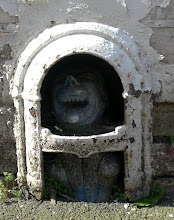
(In response to one of the comments posted, the site is almost opposite the  drinking fountain by Cannizaro Road (B281)  and in front of a very nice house. However I do like the suggestion of a Womble letter box!)

View Larger Map

Friday, 27 March 2009

The Great Wimbledon "What Is It?"

I received an intriguing tip-off from a friend the other night about an 'interesting object' that he often passed in Sunnyside Road, Wimbledon. He kindly attached a photo of what looked for all the world like a strange alternative-universe variation on a Victorian post box. The black and green livery looked very smart though and it obviously required further investigation, so I paid a quick visit during my lunch break.

It wasn't too hard to find, sitting at the end of Sunnyside Road just by Sunnyside Passage. I don't know what your first thoughts are on seeing it below but, as there was a padlock on what was obviously a door, I thought it might be a way of providing access to a ladder that led down to the main sewer.
That didn't seem all that convincing though as being perched on the top of a hill at the end of a fairly isolated road didn't seem like ideal main sewer territory. Very intriguing though, especially as this picture shows double hinges allowing almost half of the object to swing open like a wardrobe door. Any thoughts yet?
As you can see from the pediment the whole object was really quite ornate with quite a spectacular point on te roof, reminding me of some sort of kiosk from Topkapi Palace in IstambulAha! Could this be another clue? Ventilation holes running underneath the lid. Could this be to help disperse any noxious fumes from the sewer below? But again a nice show of cast-iron decoration. Whatever it is there's obviously been a lot of thought gone into its design and decoration.
The locks are not new either and provided a major clue as to the actual use of the structure. Getting a bit of an inkling now??
Then when searching around the back I caught sight of a plaque.I had to photograph it from the other side and through the foliage but it really gave the game away when I read the inscription "The British Electric Transformer Co., Hayes, Middlesex".
So there it was, this attractive and unusual object was a very early electric transformer box, the sort that these days seems to consist of either a bland box up against a wall or those strange little brick buildings if they are a bit on the larger side. The padlock clue was the fact that it was stamped with the initials L.E.B. which stood for the London Electricity Board
The LEB ceased to exist in 1990 so those padlocks have been around for a few years so I hope through all the changes in ownership that no-one lost the keys! There were other clues, including these electricity covers at the base of the unit, but all in all an intriguing and interesting piece of street furniture.

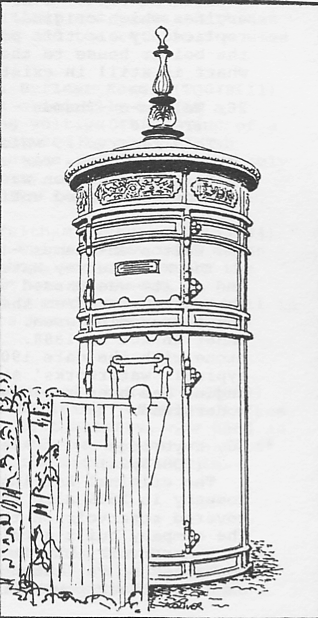
A quick google found another example listed in Molesy and recorded by the local Industrial Archaeological unit Their explanation was that it was used to 'boost the flagging voltage at the end of a long supply feed' which would make sense for this site too. However I don't think their illustration is quite as ornate as the Wimbledon example, especially when it come to the pediment. Definitely the same overall design though...

If you wanted to get seriously nerdy, it could be that the kiosk originally housed a Static (Berry) Transformer 1919 if this book published by the British Electric Transformer Company can be taken as good circumstantial evidence. Anything beyond that though would be total conjecture. Anyway it's a really pleasing object and a real find!

Monday, 23 March 2009

Trueform Uncovered - and a couple from Kingston,


Many thanks to Sebastien Ardouin for putting me on to this one. I had recorded the presence of this Trueform ghost sign in Wimbledon High Street some time ago but Sebastian had noted that the modern poster had been removed. Sure enough the sign is now revealed in all its glory and the fact that the gantry has also gone makes me wonder whether it is going to stay that way for some considerable time. Anyway its worth getting a photo as soon as possible as you can never really tell what's going to happen next!
What's also clear is that the sign was originally painted before the smaller neighbouring shop had extended its frontage to cover the lower section of the sign, making it impossible to see unless you are at some very strange angles.Whilst I'm looking at a ghost sign, how about these two from Kingston to top it up. I spotted this one on the pedestrianised High Street. I would imagine there was originally a company name in a lighter typeface which has disappeared but the secondary text is still just visible below. It seems to say Local Arms China but that doesn't seem to make much sense unless there was a type of china called Arms! But is this a 'trick of the brick'? Does it actually say Rams ? Neither leap out as obvious suggestions though...
The last example must be well- known to everyone who has ever driven around the Kingston one-way system. I can't recall what it's called these days (or what goes on there either) but even with the original signage removed the Empire 'ghost ' is hard to miss.

Thursday, 1 January 2009

Lightwells and their variants

Having recently completed the piece about the Hayward Brothers company, I found myself up in Wimbledon Village one morning and thought it would be an interesting exercise to have a quick local survey to see what lightwells there might be - especially those produced by Haywards themselves. For such a small High Street there were a surprising number of different makers and styles, including a few more primitive alternatives to the usual Semi-prismatic lightwell which were well worth recording.

Of course I couldn't resist keeping an eye out over the next few days either, so there are a couple of examples from Hampton and Kingston included as well.

Lightwell and grating
One of the interesting things I found in the Village were a number of metal grills, the precursor of the now familiar semi-prismatic lights. In these examples the cellar had a 'normal' window whose light came from a pit dug down below ground level. This pit was covered by a protective grill to stop people falling down it. The light might have been useful, but the pits often had water flowing down them in the winter and rubbish building up during the summer. Not an ideal combination.Semi-Prismatic Stall Board
This is a more sophisticated option. Here the vertical window is placed beneath the ground floor window so that it acts as a sort of attic light for the cellar. Some of the prisms are angled in order to diffuse the light but the majority would produce a spotlight effect.

The Hayward Brothers Company book has an illustration showing the difference between the two main systems. Not surprisingly their main format seems to win hands down...

The Improved Pavement Light Co. Ltd.
A quick Google for this company doesn't provide much illumination (boom! boom!) which is a little surprising as I'd spotted another of their items some time ago.
Wimbledon High Street SW19
Church Road SW19 A 'Marlborough' from the "Improved Pavement
Light Co. Ltd."
Wimbledon High Street SW19 The rather attractive colour of the glass is caused by the effect of ultra-violet rays on elements in the glass.

E. Maclean & Co., Glasgow (Wimbledon High Street)

Where most street furniture tends to be local, this example seems to be the exception that proves the rule. Intriguing though it is to find it so far south there's nothing I can find to explain how it might have ended up here. Quite a neat design though with less metal being used than most.
Lely's Semi Prism Lights

Another company for whom a superficial search turns up nothing.Does Station Approach still exist?

T Hyatt & Co, 9 Farringdon Road London (Kingston Road, Kingston)

More holes than a Gruyer cheese, this particular example is outside a pub on the approach to Kingston. The pub is still open and presumably doesn't mind a bit of damp in the cellar now and then. Still, this particular lightwell raises the possibility of an American connection, mainly to Thaddeus Hyatt of New York. Could he have had a London agent, eager to make inroads into the Hayward Brothers business? This advert from Glassian seems to back that up.

JA King & Co, 181 Queen Victoria Street EC4

Possibly an example of their 'Ferro-Glass' lightwell range, this is a pretty standard version of the Hayward model. More company details on Glassian's site.

The British Luxfer Prism Syndicate Ltd.
Glassian has a section about the British Luxfer Prism Syndicate Ltd on his superb resource page. The company were founded in 1898 and changed their name to British Luxfer in 1928, which narrows it down this particular example to a thirty year period!Hayward Brothers Ltd
Who's the daddy? As usual the company with the greatest representation are the Hayward Brothers.
I assume they could make a lightwell to fit your hole so the sizes would vary, although there appear to be at least a couple that
Wimbledon High Street SW19

Wimbledon High Street SW19 Some superb colouring on these ones..


Above is a 10 by 5 grill... and below is a 9 by 5 grill. Looks as though no hole was safe!

I find the colours in some of these lights quite attractive, almost as though they've been made out of amythest.
Concrete Mounting The shape of things to come! Reinforced concrete must have been a lot cheaper and quicker than metal frames and would have had an air of modernity about it when first introduced. Regent Street in London is a good example of these early examples although America seems to have adapted them much earlier.
Miscellaneous

Hexagonal design - Creek Road, Hampton Wick An interesting design with, sadly, no hint as to who the manufacturer might be.

Barons Court Another interesting design with a striking black and white mosaic effect. I've seen a couple of these but they have been in very poor condition or mostly covered by tarmac. This is by far the best example I've spotted. Sadly also annonymous...

Thursday, 13 November 2008

T. J. George - Coalhole

T.J. George - BatterseaHaving taken an interest in coalholes, one thing that's become apparent is that many of them seem to have been produced locally by small scale producers and local ironmongers. However I've no idea if this was really the case - for example did these ironmongers really cast their own coalholes as would have been suggested at first glance, or did they actually produce designs that were then sent off to foundries for them to cast enough to fulfil the order, enabling these small-scale businesses to provide 'local coalholes for local people'. The example above is a case in point. I came across this one outside a large (now multiple occupancy) house in Pelham Road Wimbledon. It seems to have been cast by a Battersea Ironmonger called T. J. George, a producer I hadn't come across, even when I'd visited parts of Battersea. As my own perception of an ironmonger is a small shop manned by several blokes in their sixties wearing brown coats, you have to wonder if an operation like that would be up to casting molten iron. Would the returns be worth all the set-up costs? A bit more research is required I think, but for the time being I'd be happy to add T.J. George to my list of coalhole manufacturers

Wednesday, 29 August 2007

Kingston Road, Wimbledon SW19

Map location

Kingston Road runs along the southern edge of Wimbledon up to its border with the leafy environs of Merton Park. There’s an air of civic virtue in the buildings compared to those going the other way toward Tooting – Masonic lodges, Salvation Army, Clubs, St. Johns Ambulance, colleges and council buildings all to be found within a few hundred yards of each other. There are still roads full of small Victorian and Edwardian cottages to the north and still lots to be seen above the frontage but this is definitely a road of plaques and inscriptions.

1) Starting off from Pincott Road I noticed a pub sign that I’d missed before. Although now ‘The Kilkenny Tavern’ it seems it was previously known as ‘The Dark House’, which has to be one of the least uplifting pub-names ever!

2) Crossing over by South Wimbledon tube and we are in Kingston Road proper

3)There’s a fine building down on the left hand side with a neat metal sign over the entrance. Now known just as ‘The Manor Club’ it now hosts concerts and is hired out for functions.

The interesting thing on this plaque is not so much the fact that it opened in 1890, but that the president of the club was John Innes esq. He of the horticultural fame who is probably best known as founding The John Innes Institute and having a range of potting compost named after him. I don’t know much about the club's history or original purpose although as John Innes was Lord of the Manor of Merton it might be named 'The Manor Club' a bit of self-aggrandizement!

4)Slightly further down the road is the Merton Masonic Lodge with another intriguing inscription. ‘Be Traist’ doesn’t seem to be a specific Masonic motto but a bit of searching on the internet reveals that it means ‘Be Faithful’ and, (surprise, surprise) just happens to be the motto of the Clan Innes! What are the chances of John Innes also being the first Grand Master of the Lodge? I’m not sure about the crest though although I suppose there’s a good chance that it’s his as well…

5) No longer used by the council these offices are elegant and again part of the development of the area at the turn of the century.

6)Just a few feet down is a building definitely not from the turn of the century but still dedicated to the public good. The slightly battered emblem from the St John Ambulance yard.

7) Some nice tile work between the shops heading down toward the tram lines. I might be tempted to do a collection just of this sort of tile work as it always provides a quality comparison to the modern paint and plastic that usually surround it

8)I crossed over at the tram line at Hartfield Road to take a look at one of my favourite local buildings, now boarded up. It is the shape of a very thin slice of cake and used to go by the name of ‘Ju-Ju Dinner Jackets Café’. A real exercise in squeezing the maximum of space out of a site!


9) Heading back to South Wimbledon on the other side of the road I spotted this on the wall above a Chinese take away. A good luck sign maybe?

10) Checking the dates it's apparent that this old street sign hasn’t been touched since at least 1965 when the Borough of Wimbledon was abolished.

11) One of a row of about six of these ‘Improved Patent Safety Plate’ coal-hole covers in front of a row of shops.

12)This plaque was one of two on the Wimbledon School of Art. Apart from being a teacher with two pupils I’m not sure if it has any deeper significance.

13) You can't miss this this slightly naïve and odd looking bit of wall art on the corner of Palmerston Road. From the ornate quality of the windows and general layout I believe it was originally a pub called the Lord Palmerston. In fact I’m pretty sure I remember it operating as such about five years ago.

14) The last plaque of the walk belongs to the Salvation Army and is a bit boring to be truthful. It’s too high to have a look at what seems to be quite an ornate pattern and it looks as though it’s been stuck on as a bit of an afterthought.

15) Back near Pincott Road again and my eye was caught by this lively but crumbling bit of tiling above a motorcycle shop. I couldn’t think what the building might originally have housed and the only thing I could tie in with its rakish demeanour was something like a billiard hall, although it’s probably a bit on the small side. Any ideas?