Showing posts with label coalholes. Show all posts

Friday, 27 May 2011

The Kings Road (1): The Coalholes

I had to make a quick trip up to town the other day and I managed to remember to take the camera with me. Not that I was out for long, just a short trip from Sloane Square tube along the Kings Road to Flood Street, but I did take the opportunity to have a quick stroll down a few side streets to see if I could spot any interesting odds and ends.

As it turns out, the side streets off the Kings Road in Chelsea have some very nice terraced houses and as few of them seem to have avoided having their pavements replaced (for the time being at least) I had a bit of a bonanza with the coalholes. One of the effects of having new pavement arriving on a fairly frequent basis seems to be that the coalhole covers themselves are removed - for scrap presumably - the holes are filled then covered and another bit of old London bites the dust. Apart from the ubiquitous Hayward Brothers there did seem to be a very local flavour to the coalhole companies represented. Take this one for example
Green & London, Chelsea, London, SW
The London Street Directory of 1921 records the business of Green & London as being situated at 121 Kings Road but apart from having an advert in the 1908 Chelsea Historical Pageant - where they also advertise their Gas & Electrical Fittings; Builders & Engineers supplies and their Brass Foundry - I can't find much more about them. 
C. L. Hacking, 259 Kings Road, Chelsea SW
The same London directory as mentioned above also lists Charles Leonard Hacking, ironmongers of 259 Kings Road ( In fact only the third of the Kings Road ironmongers hasn't yet been identified in association with a coalhole cover is Samuel Wilkinson Kerwood and he could pop up at any time!) Charles Hacking seems to have been involved with some of the local Pre-Raphaelite painters - not only doing some repairs and replacing a grate for the Carlyle's (30 shillings to them. Special price) but also creating some props for their paintings most notably the centrepiece brass lantern for William Holman Hunt's The Light of the World.
Brass lamps. A welcome change from cast-iron coalhole covers.
 In 1894 Charles Hacking was accepted as a member of the Evangelical Alliance and the following year put in the winning tender to install electric lights in the Upper Hall of  Chelsea Town Hall with a quote of £48, so he was obviously a man of many talents and of some faith as well.
A. C. Woodrow & Co., London
1954 might seem a little late in the day for coalhole plates, but  A. C. Woodrow & Co were still offering them for sale through publications such as Roads and Road Construction. In fact A.C. Woodrow specialised in cast iron castings throughout their history and are one of the most commonly seen names on manhole covers and other street ironware. They seem to have started off in Holborn, London but then moved out to Kent where they were still going strong at least into the 70s, and even now, for all I know. One interesting snippet caught my eye from the Municipal and Public Services Journal of1970
This golf trophy - imaginatively combining the scale model of a manhole cover surmounting three silver replicas of the Minoan axe - has been presented to the staff of Milton Keynes Development Corporation by A. C. Woodrow and Company. The Woodrow trophy will be presented annually...[at] the Tower Club...
Sadly I couldn't find a picture of this 'imaginative' trophy. I wonder if it's still being contested to this day?
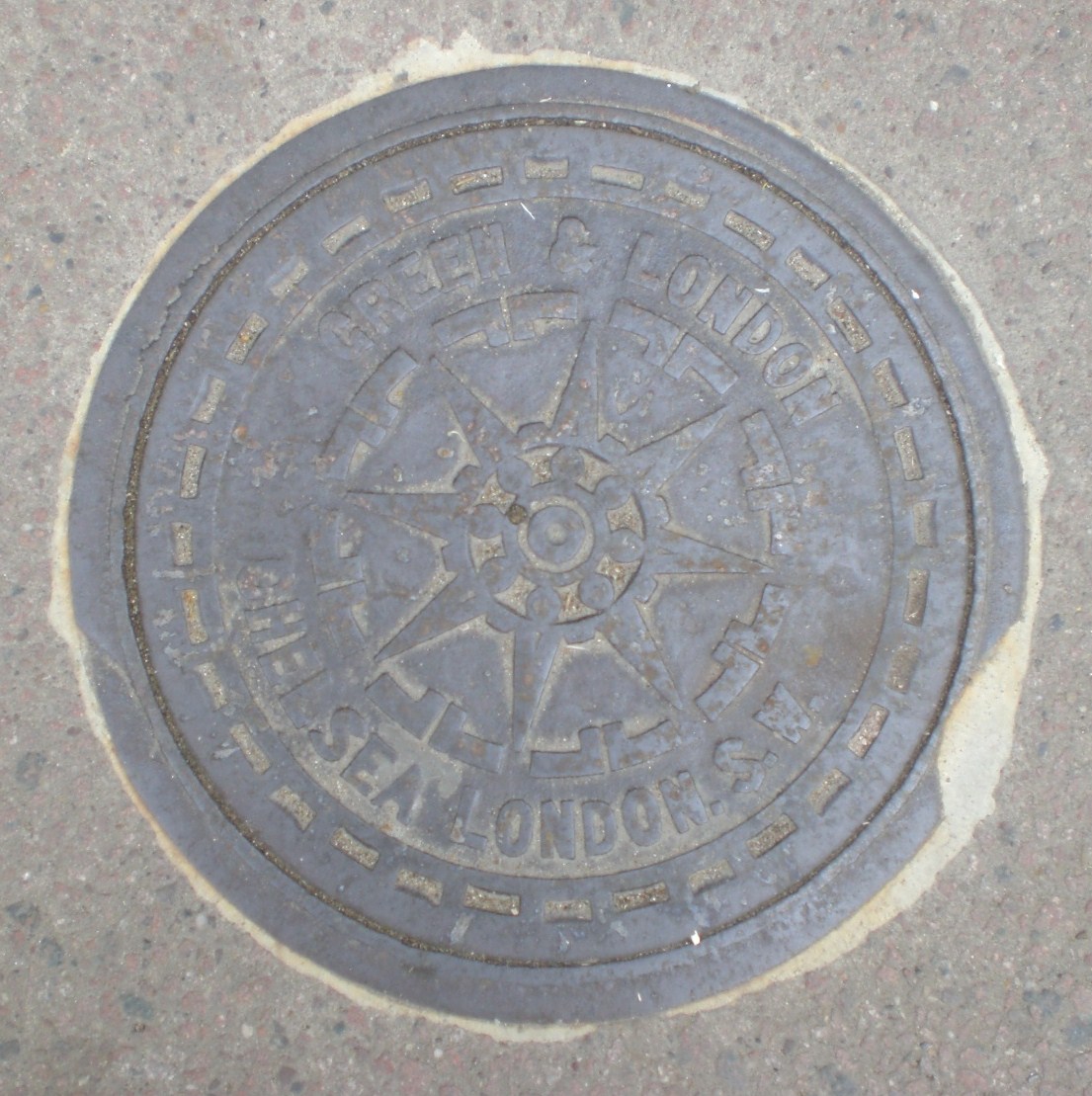
J. W. Carpenter, 186-190 Earls Court Road, SW
Quite an interesting design here produced by J.  W. Carpenter Ltd., which reminds me somewhat of a compass design. According to Gillian Cooksey in her book "Artistry & History Underfoot" has looked into the history of the company and apparently it's still trading as the Cargo Homeshop, currently celebrating its 135th birthday!
R. R. & J. Pearson, Patent Automatic, Notting Hill Gate

The Pearson's not only seem to be significant local ironmongers, as evidenced by the number of coal-hole plates in the area, but were also engaged in speculative building projects. Sadly this doesn't always seem to have gone quite to plan every time. In 1869 R. H. Pearson (ironmonger of Notting Hill) and a Mr Tidesley (brickmerchant) appear as trustees seeking the bankruptcy of Henry Saunders (builder) of Kensington. A later appearance in the records shows that by 1893 The Statist magazine was discussing the make up of Mr Robert Henry Pearson's wealth (and the fact that he had over 200 people working for him at the time) so presumably that was the year of his death.  The business carried on though and in 1900 the British Architect magazine were reporting news of other, more domestic products, although coal hole plates were still on the menu
RH & J. Pearson, Limited, wholesale and manufacturing ironmongers, High Street, Notting Hill, W., have just issued an illustrated catalogue of their well- known specialities in close and open-fire kitchen ranges
So a significant supplier of local coal hole plates then and appearing on our posting today with what I think is a very attractive design with the seven circles with leaf cluster details.
Durey
This Durey plate is a bit of a puzzle. There were plenty about and compared to the others its fairly plain typeface and layout seems to be more modern in style. My first thought was that the plate might have been the work of a modern company of the same name, Durey , who specialise in manholes. However, according to their website they were only formed in 1975 which I would have thought was a little on the late side fro coalhole plates. So, it seems there's a bit of a mystery to end on with this one...

Thursday, 16 December 2010

Elizabeth Street, Belgravia

Elizabeth Street probably isn't a London thoroughfare that rings bells with most people. It certainly didn't ring any bells with me until I found myself taking my wife there for a birthday visit to a specialist perfumer with the promise  of a birthday scent not bought from the local Boots. Les Senteurs was the intended destination and, for someone with with a slight  background in the wine trade, I have to admit it was an interesting and less intimidating experience than it might have been. For one thing smelling perfumes is not all that different from smelling wines (and there's certainly a lot less spitting) and for another the assistant was very obliging and was more than happy to provide samples to take away and try. Which is a roundabout way of saying that not only did we get to try a load of perfumes, but I was also spared the pain of actually paying for any (for the time being at least). Result!

Not expecting anything like such an agreeable experience, I'd also taken the camera along, just in case anything interesting took my eye.  Elizabeth Street is a few minutes walk from Sloane Square and the Royal Court Theatre, just off the northern branch of the Kings Road , so one of the last things I'd of expected to stumble across would be a ghost sign. Yet there it was. Almost as soon as we entered the street we could see a small mews off to the right with a still visible "Horse Infirmary and Shoeing Forge"
The view from inside the Mews - not the best of angles
It looked as though there had originally been more advertising on the top section as well as at ground level, but these had long since ceased to be visible. Still, it's a nice reminder of the original status of these small urban spaces.
     From Elizabeth Street the sign is much clearer
So, looking up was a treat, but looking down was quite interesting too. There were a couple of interesting coal-holes still in place, including one from "A. Smellie - Westminster"
Notes & Queries - Oxford Journals 1906


It's a fairly ordinary design, but I did find mention of the construction of a new building for Mr Smellie so I assume he must have been a well established local producer, and in fact Rochester Row is not all that far from Elizabeth Street, so he probably was the local supplier.

 The other designer coalhole is made by  'Luxfer Prisms 13 Hill Street London EC'.

The interesting thing about this coal-hole is that the glass prisms that would have originally helped illuminate the gloomy coal cellar have long since been replaced by concrete infills. Glassian has some more information about the Luxfer company which was producing fairly late versions of coalholes.
Luxfer Prisms - minus the prisms...
 The last items to catch my eye were a couple of plaques flanking a narrow jewellers window.
"Ornaments in Hair Plait and Mounted on the Premises - Gold & Silver Bought"
"English & Foreign Clocks & Watches Cleaned & Repaired By Experienced Workmen
 Although now under new ownership the original plaques have been left in place and make a very attractive setting either side of the main window. The company seems to be called J. Desforges but I haven't been able to find out much about them to date. The fact that working items in hair seems to be a big part of their business would suggest a late Victorian date for the company. It's an interesting use of a garter or belt motif as well although it may just be a decorative notif rather than signifying something like a Royal Warrant. Very intriguing ornaments though and credit where it's due to the new owners who must have been tempted to take them down in order to widen their window space.

I may have to go back to buy some perfume at some point but I have to say that Elizabeth Street provided me with more than a couple of unexpected pleasures!

Tuesday, 7 September 2010

A Brick Lane Coalhole... OR IS IT???

Or is it indeed....! I was visiting the Brick Lane area a couple of weeks ago and of course had half an eye out for anything of interest that might take its fancy. As it happened, just by the mosque, something did - a very unusual coal-hole which when viewed from one side didn't seem to make much sense, but if you took the trouble to walk around it - voila! a perfect little planet Earth in miniature
 All the World's a Coalhole! - Brick Lane
I couldn't help but be more than a little suspicious though. It was the right size for a coal-hole, it was the right shape for a coal-hole, it was even in the right place for a coal-hole but to be honest it looked a bit too arty to be a coal-hole. Certainly none of that symmetrical 'design made on a wheel' look about it that's typical of the true ironmongers coal-hole.

There was nothing else around to give any clues as to what else it might be though, so I had to wait until I was home to find out what it was I'd actually stumbled over.

What I found after a bit of searching was that it wasn't a coal-hole but something called a 'Spitalfields Roundel', one of a series of 25 individual images by local artist Keith Bowler that were created and placed as the result of the Bethnal Green City Challenge in 1995. This was a five year regeneration project for the Bethnal Green area and the roundels were one aspect of much of the work that took place in the area. The roundels were cast in iron locally and depicted scenes and images of importance locally. The globe outside the mosque was there to signify the historic  importance of immigration to the area

The 'Know Your London' website has lots more information on them including some nice sepia photographs. One thing that I did wonder and which wasn't clear on the website, was whether these roundels were sited in existing coal-holes or were they in effect plaques embedded in concrete? What I also find quite surprising and a little sad is that of the 25 roundels put in place in 1995, only 12 are still known to be in existence. Presumably the others have fallen victim to pavement repairs or rebuilding and their fate is not known. With 13 gone within 15 years you'd better get looking quick if you want to see any of the rest!

Thursday, 22 July 2010

London Coalhole Cover 'Lost' In Maidstone!

I was in Maidstone, Kent this morning for a bit of a family 'do' when I came across this interesting coalhole cover. I say 'came across' but actually it had been covered with a very heavy A board which I had to grapple to the side before I could get a good look.

'Faded London' has been on tour before and as we are looking at a London foundry - and one I hadn't recorded before - I felt more than justified in adding it to the canon. As you can see it's quite an ornate and interesting design with quite a lot of clues as to the producer

The Hope Foundry Co.
5 Upper Thames Street
London EC 

Despite all the information I haven't had much luck so far in tracing the Hope Foundry and it's not listed in Gillian Cooksey's excellent "Artistry and History Underfoot". There are certainly mentions of the name, such as this one
Hope Foundry Co.
The Hope Foundry and Engineering Co. is recorded as making sad irons at the Hope Works in West Bromwich, c1866. It is possible that there was also a Hope Foundry in Leeds.
but it's more than likely that these were entirely seperate enterprises although I supose I can't rule out the possibility of a London branch. In a trade journal from1870 I also came across the General Iron Foundry Co. oalso based in Upper Thames Street that was apparently selling stoves, mantels, and bronzes but again whether or not this has anything to do the Hope Foundry - whether by using the same site or just by way of a change of name - remains to be seen.  

There were quite a few small-scale local foundaries at the time and I suppose it's more than possible that many weren't that long lived. It could be I've a bit of a rarity here but only time and a bit more research will tell.

Thursday, 1 April 2010

Belgrave Square And The 'Ghost Signs Archive' Launch

March 18th saw the launch of a wonderful collaborative archive between Sam 'Ghostsigns' Taylor and the History of Advertising Trust . Basically Sam has been working hard to establish a national photographic database to provide a record of this unique form of advertising and the launch took place in the IPA building in Belgrave Square. Sam very kindly invited those who had contributed to the archive along for the opening and being a sucker for both Ghost Signs and a free glass of wine, Faded London was more than happy to join in with the celebrations.

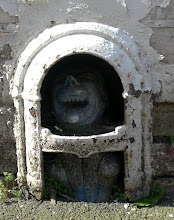
Never having knowingly visited Belgrave Square, and not being one to miss an opportunity, I took a quick spin around the block in the closing gloom before making my dazzling entrance at the launch party. There were a couple of interesting items as well, not least of all this water trough at the top of Grosvenor Crescent. 
It's part of an edifice that serves as frontage to a building that was originally St George's Hospital prior to its relocation to Tooting. It's now the Lanesborough Hotel and has been scrubbed up a bit.  I found this detailing on an Images of England English Heritage site and am pleased I did as it throws a little more light on the organization responsible for all those granite cattle troughs dotted around the capital
Attached drinking fountain on Knightsbridge façade. Inscribed "MDCCCLX" (1860) on the frieze. Erected by the Metropolitan Drinking Fountain and Cattle trough Association. Fluted shell basin of carved stone on a rough stone base flanked by stepped plinths surmounted by acanthus leaf consoles carrying a frieze and cornice with scrolled pediment and central finial. One of the earliest drinking fountains erected by the Association, a hospital being seen as an appropriate location. Founded in 1859 The Metropolitan Free Drinking Fountain Association (Cattle Trough added 1867) provided free fresh water to many humans and beasts at a time when ale and spirits were easier to obtain than water and most supplies contaminated. 
There would originally have been cups attached to chains for the ease of drinkers, but these have long since either been removed or broken off.

Continuing around the square and tucked around the back is the Norwegian Embassy building. Either side of the Front door are these two small but interesting friezes showing cherubs engaged in what I assumed at first must be typically Norwegian activities.
A bit of art going on in this one with some painting and sculpture along with what looks like some architectural consultation judging from the stonework lying about the place.
 The other side stays in the country with its rural theme of shepherding, growing crops and taking some time out for a tune on the pan-pipes. There was a plaque explaining some of their history
In 1796 these two coade stone reliefs were affixed to the Danish-Norwegian consulate in Wellclose Square Stepney. In 1968 the reliefs were re-erected on this embassy by courtesy of the Greater London Council
 In know what you're wondering... 'what's coade stone?' Wikipedia has the answer, of course
Coade stone was a ceramic material that has been described as an artificial stone. It was first created by Mrs Eleanor Coade (Elinor Coade, 1733–1821), and sold commercially from 1769 to 1833. 
So it looks as though the date of 1796 puts it right in the middle of the production period and it's not as if there are lots of them about as there are only about 650 known surviving pieces. Apparently lots of decorative designs were sold 'off the shelf'  so there's a good chance that they're generic cherubs and not even been produced with Norway in mind! 

Having exhausted the square I finally arrived at the launch party and was very pleased indeed to make the acquaintance (and the re-acquaintance) of several other bloggers, as well as enjoying the speeches and the presentations. Unfortunately I was so eager to get at the wine and crisps that I left my camera in my coat pocket and only managed to get one shot of the event just as I was leaving.
Quite a cunning one as it happens as I managed to bag Sebastien Ardouin of Painted Signs and Mosaics and Caroline of Caroline's Miscellany in the foreground whilst Sam Roberts'  head is neatly framed in the background, just underneath one of the slides.  The evening was a great success and full details of the launch and the archive itself can be found on it's new searchable website. Well done to Sam for all the hard work he's put in over the last year!

But the evening wasn't yet over. After making my excuses and disappearing silently into the swirling London mist I caught sight of an intriguing coal-hole cover and managed to get a reasonably clear picture. The inscription reads "Luxfer Prisms 46 Hill Street London EC"
Luxfer Prisms were a company better known for their glass cellar lighting panels rather than their coalholes and previous examples I've seen would have had glass inserts instead of holes, which would have been more in line with their core business. Glassian is the place to go to find out more about the company and one interesting comment is the origins of the word LUXFER being  'from the Latin words lux (light) and ferre (to carry)'.

And as the light by then had pretty much gone it was a good time to put the camera away carry myself off home. An enjoyable launch and congratulations to Sam once again on all his hard work.

Sunday, 12 July 2009

From Hammersmith to the 'Bush & back

I haven't been out and about north of the river as much as I ought, so finding myself with a rare free afternoon one Saturday I set off for Hammersmith with intention of having an enjoyable walk up to Shepherds Bush and back. Which is what it proved to be.

This is pretty much the route taken, straight up to Shepherds Bush,along Uxbridge Road then down a back street to meet up with Goldhawk Road and back to the Bush again

View Larger Map

Not a particularly long walk or all that adventurous really, but there was plenty of interest along the way, starting off with this bit of ironwork
Shepherds Bush Road, Hammersmith
It's the sort of iron scroll-work that's hidden in the folds of an old building integrated into a more modern design, but certainly adds a bit of class. Worth finding a spot in the middle of a traffic island for anyway.
Hammersmith Palais, Shepherds Bush Road
The Palais has seen better days, as this battered date sign suggests. In fact it's ready for demolition and had I but known it there is an original 'ghost sign' at the rear overlooking the railway lines. Despite the date here, the Wikipedia article has it opening in 1919.

I was a bit surprised that nothing much more caught my eye up until I reached Shepherds Bush itself, although I did find a few more interesting pits and pieces on the return journey. Still, my patience was rewarded when I went poking around the O2 Theatre on the Bush and found this fascinating sign hidden down the side.
Shepherds Bush Green
"Cinematograph Theatre Continuous Performance seats 1/- 6d & 3d" Well you could hardly call it a Faded Sign but I can only assume that when it was built this side alley was a bit more lively and worthy of such a sign. I don't think they'd bother today...
Wood Lane, Shepherds Bush
The first of the afternoons true ghost signs this one looks as though it was originally a garage. I can't quite make out the writing below - 'Outfit' maybe?
Uxbridge Road Turning to the left and heading down the Uxbridge Road, there are some retail units and restaurants in what seem to have been old offices of the London County Council. That was abolished in 1965 but the old signage has clung on, just about...
Shepherds Bush Library, Uxbridge Road
I was very impressed with this chimney-brace come date-plaque. I can't recall seeing one like it and on the whole I'd have to say that it's very impressive.
The library itself has a number of ornate scrolled plaques commemorating its benefactors - this particular one celebrates Leigh Hunt and Thomas Keene. I'd be interested in knowing more about the connection these two have with the library. Leigh Hunt seems to have been a fascinating character, but for the most part poverty stricken, dying just across the river in Putney in 1859. Charles Keene was an artist, specialising in black and white illustrations and etchings who died in 1891. With 32 years between their deaths it's strange that they should be remembered together. Could it be they were friends of the library's founder, John Passmore Evans? He was a journalist and newspaper owner so might well have know of the work of the two and decided they were worth remembering.
Uxbridge Road Another ghost sign and again pretty faint. Could that be 'Allinsons' or 'Allen & Son'? Either way, there's not much else to be seen.
Oh come on now, what is it with this place? A third Ghost sign, potentially the best of the bunch and it's so tantalisingly faint you can hardly make out what it was!
Of course once your eyes focus in what we have here is a Players Navy Cigarette sign,
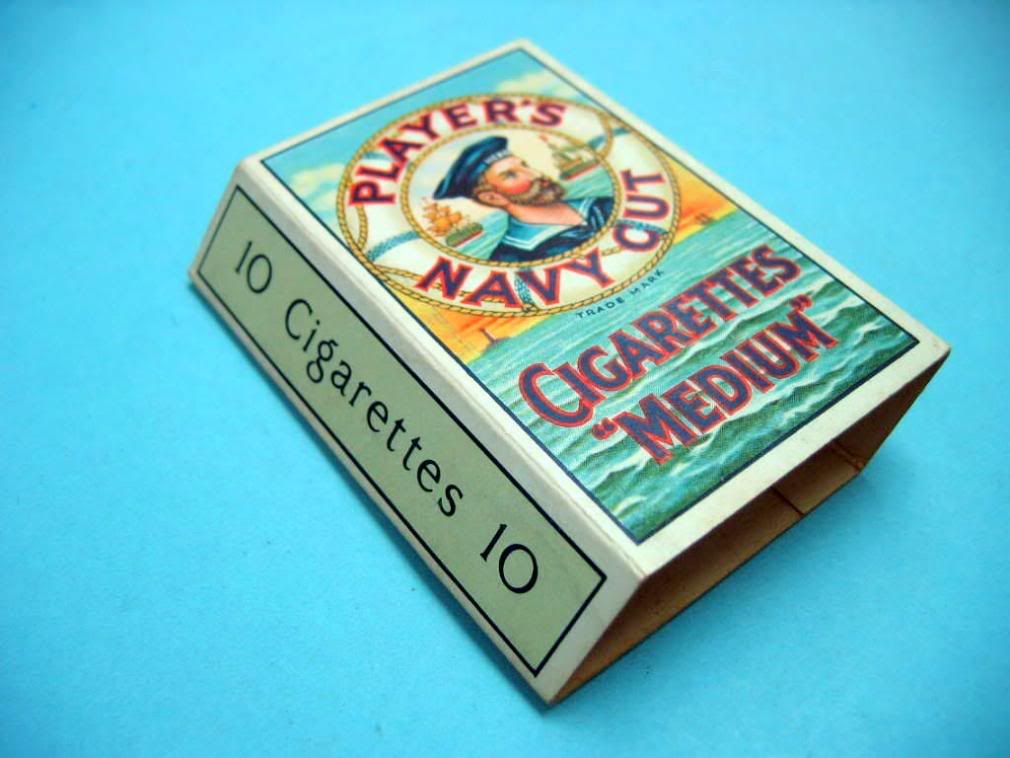
Originally in various shades of blues and whites with a Jolly Jack Tar peeping out the middle of a life-belt this once impressive sign has faded away to almost nothing. I think I'm about thirty years too late on this one.

Telephone Exchange, Uxbridge Road. This strikes me as being fairly typical of the straight-forwardelements found in telephone exchanges. 'Modern' buildings with a nod to the classical, in this case the staff and serpent symbol known as the Caduceus, carried by the Greek God Hermes and then later on the Roman God Mercury, after he retired. I'm sure you wouldn't confuse this sign with the medical Rod of Asclepius although it's not an uncommon error even though the medical sign just has one snake and no wings. Personally I suspect it's been appropriated because of its symmetry and more pleasing aesthetics but there you go...
Uxbridge Road I'm not only drawn to this one because of its obvious age, slightly faded grandeur and classically-cracked masonry, but also because of the the anti-pigeon net lends it an air of Ena Sharples-ness (although to be fair it doesn't show up too clearly on the photo)
Uxbridge Road And finally on the Uxbridge Road, an interesting example of a Haywards Lightwell. Interesting (well to me anyway, I don't expect many others to be leaping up and down with excitement) because it looks as though it's hinged with four handles ('Fork 'andles?') set into the middle. As the glass was prismatic and thus fairly deep, I'd of thought it would have made such an entrance unfeasible, but apparently not. I wonder when it was opened last though? Having the new shop-front projecting over one edge couldn't help much.
Conningham Road The first of a couple of nice coal-holes, this one was just up someone's garden path, which always poses a bit of a dilemma. Is it acceptable to open a gate, take a step in and photograph someone's coal-hole or should I knock on the door and go through a very convoluted explanation as to exactly what I'd like to do and why I'd like to do it? Very tricky. If the gate is open and it's obviously multi-occupancy then I tend to pop in for a quickie. If it's a family home and the gate is closed then I pass on by swiftly and try to put it out of my mind as quickly as possible. Luckily this one was one of the former...
The 1901 census only shows one Selden who was an Ironmonger in London and that was Alfred born in in 1859. On that basis I think it's probably a reasonable assumption that these photos are of the son in 'Selden & Son', later to die in the Great War.

Conningham Road Not quite as attractive, but still with a vibrant, mannish swagger about it, an example from further down by John Harvey, New Road, Circus Street which is slightly confusing. A bit of searching shows a Circus Street New Road in Marylebone and the 1901 census does show a John H. Harvey, Shopkeeper, in the area but it doesn't specify his shop (i.e. ironmonger). One for a bit more research I think.
Goldhawk Road - This shop caught my eye as it seemed to be squeezed between to older and more established buildings. Not only was it freakishly slim but the air of surreality was added to by a suspended bowler hat. I say 'shop' because there was no indication as to name, trade or profession, just a bowler hat gathering dust. Very mysterious...
Goldhawk Road Just along from the shop was a nice example of Old and New in the shape of a bell-pull and an entryphone. Definitely not a button, the bell-pull had been painted over so many times it was almost like it had been polyfillered.
Goldhawk Road (possibly Godolphin Road)- In amongst the usual modern shop fronts I found this remnant of an earlier era, tucked around the side. Bransdon are still recorded as being newsagents based on the Goldhawk Road but I guess the flakey old sign can't compete with the lure of modern, shiny, yellow plastic.
Goldhawk Road - Well here's an interesting adaptation! A couple of cows heads above a restaurant. I assume they are fibre-glass and stuck over the original pediment but very eye-catching it must be said.
Goldhawk Road (Lime Grove) - Next to a railway station, there's no prizes for guessing that this once advertised W.H. Smith & Son, although they seem to be long gone.
Goldhawk Road - Although fronted by a mini-supermarket, Goldhawk House was obviously one of the grander buildings on Goldhawk Road, several stories high and capped off with this solid, dated section.
If the sign on the side of the building is anything to go by it was a builders supplier but it seems too grand an effort for that, so possibly this refers to later occupants. It has the air of an institution about it though, so maybe it was a working man's self-improvement society or something.
Goldhawk Road - Just before Shepherds Bush there's a row of not particularly special or spectacular buildings but they are summounted by one of the most emphatic date plaques in town. No chance of missing that one!
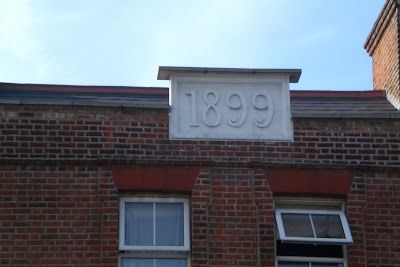
Shepherds Bush Road - Heading back toward Hammersmith now and on the left was a typically 30s design of flats, the sort that you can take for granted very easily but when you take the time to actually have a look... well it started to seem a lot more interesting. It's a nice large entrance that almost qualifies as 'grand'
Shepherds Bush Road - This one caught my eye because it seemed at first to be a midget coal-hole. Quite a nice design, but miles too small to be of any use. Then you notice that only the inner part of the design has emerged from the cement filler. Give it another twenty years and I might be able to see who manufactured it!
Netherwood Lane - Not a blue plaque, but a red one, obviously put up by a local history group or a special interest society. This red plaque commemorates Irish Nationalist leader Michael Collins and is presumably either from when he worked for the Post Office or with the firm Horne & Co.
Lakeside Road - For some reason I had strayed around some of the backstreets and was intrigued to find this geometric design above a very 'modernist' looking window. It has a 'significant' look about it but it's totally new to me. Is it a classical allusion or just a company logo?
Lakeside Road - Turning back down Lakeside Road I could just make out the remains of an occupational 'ghost sign' on the wall above me. It looks as though this was once the home of a Boot-Makers & Repairers.
Shepherds Bush Road - Back on the main road again and there was my last coalhoal. A fairly standard design but a new manufacturer to me R, H. & J. Pearson, Notting Hill Gate. Jonathan Pearson, ironmonger, held the lease on No.7 High Street, Notting Hill Gate in 1878–9 so might well be our manufacturer.
Brook Green - I wonder what came first, the eagle or the name? It's always nice to see an animal statue or two but I wonder if they have any effect on the local pigeons?
Shepherds Bush Library - Shepherds Bush Road "This building was the gift of Andrew Carnegie 1905" Mind you it wasn't the only one. Andrew Carnegie, reckoned to have been the second richest man of all time, was self-educated and spent much of his money on founding libraries around the world so that others could benefit in the same way he did.
And finally, to round it all off
Hammersmith Road - As well a splendid weathervane (which I'll be adding to the collection) this building has had its (presumably) original date carefully painted around over the years. I was wondering if there had originally been some other text that accompanied it, but for now it's a thoughtful act of the owners to preserve this small snippet of history.
So that's about it. Three main roads that didn't start off too lively but certainly picked up as I went along. Ghost signs, lightwells, coalholes and some interesting plaques and buildings so a couple of hours well spent.