Thursday, 19 November 2009

The Londonist Blogger Interviews

There's an interesting on-line listings and news site called The Londonist that (if I'm being honest) I wasn't aware of until they sent me an email asking whether I'd be happy to answer a few questions. Normally of course if anyone tries to ask me questions on the street I'd be trying to hide behind someone else and slip past on their blind side but as this was all done at a safe distance it seemed quite an interesting thing to do. As it turned out it was all fairly painless

It was published the other week and whilst I was having a look I noticed a whole clutch of other interviews with other bloggers who also write about London. Very interesting they were too and many of them were by individuals whose bloggs cover similar areas to Faded London. In fact a significant number of them write bloggs that I've listed as links from this site and it occurred to me that they might be of interest to others.   

So, for your ease and interest I did a quick search on their site to produce a convenient list of all the blogger interviews. Those with similar interests to Faded London include Sam Roberts talking about his ongoing project at Ghost Signs, myself trying desperately to think of something interesting to say about the idle stroll that is Faded London and Chris Partridge discussing the joy of building ornamentation on Ornamental Passions . My personal favourite for a good read is Rob's Another Nickel in the Machine , a blog that looks for inspiration to the gossip pages of the past.  Caroline's Miscellany is an lucky dip of interesting nuggets and the tapestry of images that make up Jane's London is always worth more than just a glance.

I fully expect others to appear over the coming months so it might be worth popping by now and then and seeing what's new.

Tuesday, 17 November 2009

Merton Hall Road : The House Tile Mecca of South Wimbledon

You know how it is when you're walking along on a bright autumnal day and something catches your eye - in this instance an aesthetically pleasing bit of tilework. If you see one then it's a moment of interest but to see a few in one place, well that's worth getting your camera out for.

That's pretty much what happened to me as I was strolling down a South Wimbledon street the other week. I have to confess to having a soft spot for a bit of tile work, whether it be the interior of an old butcher shop, the pillar between to adjoining shops or a (not so) humble domestic doorway. Every now and then you might also come across a few adorning the outside of a house as well, and to my mind can really catch the eye and lift the spirit. If you're susceptible to that sort of thing of course...
...otherwise you might find it a bit of a bore and an unnecessary distraction and possibly decide to paint over it!

The road in question was Merton Hall Road and at the time I saw these I wasn't aware that Merton Council had designated it with its own conservation area Actually the design guide had some useful information in it such as details of the architect and builders
The development of Merton Hall Road on the Merton Hall Estate began in 1884 when George Palmer and his architect Francis James Smith together with Charles T. Tuftin and his surveyor Percy H. Clarke commenced building. These were largely responsible for introducing the lively variety of the Queen Anne revival detail which gives the street its character.
There seems to have been a George Palmer of 9 Westbourne Terrace, Garratt Lane, Wandsworth ( a few miles away) who had a whole hat-ful of leases and mortgages in the area at that time so it's tempting to think he was a bit of a local entrepreneur riding the local housing boom. Whoever he was though you can't fault his attention to detail.

I didn't get to picture every set of tiles down the road - some were duplicated and some were obscured - but I think there's a pretty representational set here.

Quite a subdued one to start with. Not a design that shouts at you but quite pleasant all the same.
No, these two, above and below, are not quite the same although if it wasn't for the daisies you'd have to look twice to confirm it. I've no idea who produced the tiles of if they were fairly common 'off the shelf' designs. It would be interesting if anyone recognised them though.
The one below certainly is a duplicate of the one above though. I don't think I saw more than a couple of designs repeated so it certainly didn't feel like there were just job lots of tiles being used. I wonder if the brick border is brown on the one above as well?
Roughly 125 years old and they've still retained their lustre. Not many obvious cracks caused by frost or ice either
I was wondering if there's an unstated sense of tile-snobbery amongst the owners. Do residents secretly covert their neighbours tiles? And why were some painted over? Most inexplicable...
(Below) The black border gives this one a bit of an edge though. It works OK, although I think I'd prefer a white border but the design guide definitely comes out against any unnecessary paining of brick features at all. So there...
(Above) Blues, black, browns and greys - bit of a mish-mash but still colourful enough
(Above) A bit of detail from the set below, which I think looks a bit like a Navajo woven blanket on the front of the house. Not that I've ever seen a Navajo blanket but it's what I'd imagine it to look like
I think this has to be my favourite of the designs though - even if only of the interesting colours. It also seems to have a fair bit of Moorish influence in its design. Very delicate all round and a nice one to finish on.

Monday, 2 November 2009

The Weston Green Sundial...and other bits


View Larger Map


The village sign built to commemorate the Queens Golden Jubilee

Weston Green...so that's what it's called. Now at last I can stop describing it as "...the nice group of old buildings near the 'Scilly Isles' roundabouts on the straight road toward Hampton Court Bridge. You know, the green bit with the nice hidden pub and the house with the sundial on it...?"

Just about London too for the sake of this blog. Apparently it's crept into Surrey but the fact that it's within the M25, has the afformentioned striking sundial tantalisingly visible from the road and that I seem to drive past it at regular intervals means it just about qualifies.

It's no suprise that the locals have gone down the village-sign route as the ancient layout and pattern of the old village is pretty obvious even to a casual visitor like myself. The old village green, pond (nowdays more a small crater with a marsh at the bottom) the pub, church and fine houses are all still there and the large amount of traffic seems more intent on rushing by than hanging around. Well worth a quick visit on a Sunday afternoon then...
This is the splendid sundial that had first grabbed my attention whilst hurrying toward a traffic-jam in Hampton Court. The latin motto 'Horas non numero nisi serenas' translates as
I count only the bright hours and is still apparently a big favourite for those commissioning their own more modern sundials, along with Time flies and other traditional time-related mottoes.
The date seems to be 1828 and it's quite an ornate item for what is not a particularly large or ostentatious building. Rather a stern looking sun as well but on the whole it puts other sundials in the shade (boom, boom!)
This low-level weather vane was also nearby. I doubt that it's very old and it seems to be peeling in several places but I was intrigued by the subject matter of a lion and three people. I'm sure it must be an allusion but I've no idea what to.
On the same row of houses, next door to the sundial cottage in fact, here's a very handsome Georgian mansion. It's currently undergoing a bit of renovation and I was intrigued to spot what looked like an insurance fire-plate above the door. In the 18th and 19th centuries the lack of a national fire brigade meant that your fire-cover was exactly that - a small private fire-brigade would come and put out your burning house but only if you were one of their customers! Hence the need to ensure the fire-marks were in a prominant position...A slightly closer view shows a plate depicting what seems to be a temple surmounted by a crown. Some scouting around on the internet led to the discovery of a fascinating booklet on the subject called Fire Insurance Wall Plaques by Rowland G. M. Baker. It was published in 1970 and is available in full online and well worth a quick look. What it does have are some excellent line drawings of fire-plates and from that it's quite possible to identify the plaque as being from the Royal Exchange - and in fact the 'temple' depicted was actually the Royal Exchange itself

The 'Weekly Journal' of 12th December 1719 records that "On Tuesday the Society of Gentlemen Subscribers of the new project for insurance of Ships and Merchandise waited upon the King with a petition for the Grant of a Charter to carry on their new undertaking, and we hear that they were graciously received and their Petition referr'd to the Privy Council". Their efforts were successful and they granted a royal charter in 1720. The company was first known as Onslow's Insurance from Lord Onslow its first governor. It began by dealing with marine insurance only. In 1721 a supplementary charter was obtained by the name of "The Royal Exchange Assurance of Houses and Goods from Loss by Fire", from the fact that their offices were sited in the Royal Exchange. The company also used a representation of the Royal Exchange building as the emblem on their fire mark. This was the old Royal Exchange build in 1669 after the Great Fire, and which was itself ravaged by fire in 1838. That fire unfortunately destroyed all the company's old records .

What can I say. I'm a sucker for old door-bell pulls... I assume this one had a thin wire cable going to one of those merry ' bell on a spring' affairs.

Getting away from the heart of Weston Green a short walk over the common takes you Esher Railway Station, or more accuratly to the nearby railway bridge. There were an intriguing couple of bricked up doors here, between the two lines. One had a tempting glass arch still intact which apparently used to service the station platforms. Presumably these are now too dangerous and have long since been blocked up.

A closer look shows a tempting array of higgledy-piggldy stair, undergrowth and the refuse of the ages. I wonder if it can still be accessed from the station above?

Out in the open air again I spotted an interesting looking badge on the side of the bridge. A bit too far away for me but a close-up on the camera provided all the required detail.

Joseph Westwood & Co Engineers & Contractors London 1888

There are a multitude of references to this company, or at least to Joseph Westwood. He seems to have been an employee at a Thames Iron Shipyard and stepped in to stop it going bust with the loss of 3,000 jobs, and followed that up by setting up his own foundry and specialising himself in ships and railway bridges. By all accounts his company - or an offshoot of it - were still trading at least up to the 1970's and undertook a vast range of engineering tasks and roles. A nice item to finish on!

Tuesday, 27 October 2009

Morden - The King George Connection

There's a short journey I make every Saturday morning that takes me past two sets of wall plaques. Both of them are interesting in their own right but a brief look at their histories provided a common link between the two - namely King George V. Now I'm aware that this might prove to be a tenuous link but it's there nonetheless and certainly strong enough for me to label this 'The King George Connection'! (blast of royal trumpets for emphasis)

The first set of plaques have a distinctly military air about them.
There are several busts of a distinguished gentleman on the walls of some neat houses near the old village of Morden where Central Road meets Green Lane , along with some other decorative relief work. The fact that the estate is known as the 'Haig Homes' gives a pretty good idea as to who the soldier in the roundel below might be and it's no surprise to find the figure is actually of Douglas Haig, the 1st Lord Haig (1861-1928)
The image is repeated several times around the estate and isn't one specially commissioned for these houses at all, but is taken directly from his memorial at the Scottish National War Memorial in Edinburgh Castle. Having been one of the senior military commanders of the First World War and one of the generation of generals reviled for the huge loss of life involved, Haig then spent his retirement - and some of the profits of the family whisky business, I'd assume - providing decent affordable housing for the survivors.
I'm assuming that this is a representation below is of the dove of peace and symbolises a haven for soldiers who have experienced the horrors of war and survived to an old age. If not then maybe a carrier pigeon from the first world war. Unlikely, but you never know...
This site in Morden is the largest of the Haig estates and was built between 1928 and 1930. In 1931 King George V was present for the official opening on probably his first and last trip to the area! I have seen a picture of the King at the opening but frustratingly can no longer locate it, although I've no doubt that Haig Homes themselves would have a copy in their archives. The best I could do was this article in a Haig Homes magazine which shows his oldest son, the Prince of Wales, talking to some of the residents. Not quite as exciting but no doubt I'll find the other picture eventually.

There were a couple of other inscriptions around as well, like this one for example. It isn't the easiest plaque to read, but says something along the lines of
The Gift of Memorial Homes. One of Two Provided by R. K. Kielber Esq. and the name Alexandra Square was chosen by him to express the gratitude of Denmark to the Great Field Marshall
Alexandra was the name of King George's mother so would have been a most acceptable choice!

So that's one King George connection on my short trip, now where's the next?

The second set of plaques can be found either side of the (seemingly) permanently full car-park of the nearby King George's Park Playing Fields, home of Morden Little League and my ultimate destination. I had a vague feeling that King George seemed to come up quite often in the context of parks and playing fields, but it was only when I had a closer look that it really dawned on me before that there might be a particular reason for that.

An apparently pretty standard set of King George Playing Field pillars

These playing fields can be found up and down the country (471 apparently) and are actually a memorial to King George himself, set up following his death in 1936. They were the result of the Mayor of London coming up with the idea as a suitable living monument and setting up a charity to action it. The full details can be seen (of course) in Wikipedia but one of the nice quotes from that article notes that each field would...
...be styled 'King George's Field' and to be distinguished by heraldic panels or
other appropriate tablet medallion or inscription commemorative of His Late
Majesty and of a design approved by the Administrative Council.
So up and down the country, sitting outside numerous King George Playing Fields are these heraldic tablets, designed by local artists and acknowledging local materials and traditions.

Unicorn on the right pillar...

The Morden ones seem to made out of concrete set into a brick entrance. The depictions themselves are a little worn but still readable, and clearly depict a Unicorn and a Lion - both heraldic animals from the Royal coat of arms

...Lion on the left. Everything in place here then!

There are strict rules about the design and execution of these panels which are taken from the charity guidelines

Heraldic panels were made of either stone or bronze and, in some cases, brass. These panels were, and still must be, displayed at the main entrance to the field; the Lion panel to be fixed on the left of the entrance and the Unicorn panel on the right, except Scotland. Where the piers of the entrance are of brick or stone, the panels were of stone 2 ft (1 m) high by 1 ft 6 in (0.46 m) broad. Where wooden posts form the gate-supports, smaller plaques in bronze were issued - 11¼ins high by 8¼ins broad.
In the case of England, Wales and Northern Ireland, the panel on the left is the Lion, holding a Royal Shield, with the words 'George V' underneath, and below them 'A.D. 1910-1936'; and on the right is the Unicorn holding a similar shield with the words 'King George’s Field' underneath. In the case of Scotland, the relative positions of the Lion and the Unicorn are reversed, and the Scottish arms take prior place in the Shield and the Unicorn wears a crown. The wording below is identical.These panels are essential to the heritage of the Foundation. Subject to the Deed of Dedication, the fields are, in most cases, established on charitable trust and protected in ‘perpetuity’. The NPFA is glad to give initial guidance and the necessary information on the specific design.

It's only a short drive but it's interesting that a recent King of England should have such a presence on the route. Now if only I thought to check the age of the postboxes on my way I might have made a hat-trick rather than just a brace!


Monday, 12 October 2009

An Unusual Borough 'Ghost' And A Couple Of Others.

We went for lunch up at Borough Market this week so of course I took along the camera, just in case. As it turned out I spotted an intriguing ghost sign and few other odds and ends. Lunch and photos...lovely!
Southwark Street, Borough SE1
Most 'Ghost Signs' that are spotted tend to be painted on brick walls and the sides of buildings. It's not quite as usual to come across one painted on wood - not least because of its unfortunate tendency to rot away over time - so I was really pleased to spot this one the other day. It's unusual on several counts; firstly it's on wood; secondly it's very tall and thin and thirdly because of it's position under a railway line.

It seems to have been made as a specific infill between two other buildings, although it's not clear what's behind it, and my guess would be that it has been covered up until fairly recently. There's a central wooden batten that looks a lot newer and the fact that there's not much graffiti also suggest it hasn't been exposed for too long.

I couldn't fit it all in so had to make do with three separate sections:

The top section reads
FARLOW (?) & ROBERTS
SHOP FITTERS
BUILDERS CONTRACTORS
SAW PLANING
MOULDING M??
5 RED CROSS??
ESTIMATES FREE FOR
???DS OF BUILDING W??
STRUCTURAL ALTERATIONS
FR?? & DEL??
All very mysterious. I assume they must have had a yard close by and this site provided a handy bit of free advertising.

The Hop Exchange, Southwark Street SE1
This little bit of advertising was a bit more expensive I'd assume... This is the magnificent entrance to the Hop Exchange and the relief shows the cutting and bagging of strings of hops. I like the hairy 'Green Men' too which gives the whole scene a definite pagan feel.
Southwark Street SE1
The Menier Chocolate Factory not only has a very attractive front door, but also two ghost door numbers who seem to have survived by being hidden under a brass plate or something similar

Park Street SE1
An unusual and very sturdy bootscraper this one and one of a pair outside a couple of attractive old town houses. Big enough for a small child to stand on I'd reckon. Sadly I didn't have a small child with me so couldn't try out my theory.
Union Street
'Mint & Gospel' - excellent name! Actually the fact it refers to the Shaftsbury Society means that this plaque dates from after 1914, the date the Society was founded. Before that it had been known as the Ragged School Union and this had been one of their London Schools. It seems that the establishment of the Education Act of 1870 meant these charitable institutions no-longer were the sole providers of education for the destitute young and as their role slowly diminished it seems that the Shaftesbury Society eventually evolved into the YMCA. The building itself is dated 1909 so the plaque must be a few years younger, possibly being added five or six years later. Nice reminder though.
Here's the proof then, the foundation stone dated 1909. There's a nice photo of Lord Mayor Treloar in the National Portrait Gallery and as he founded
the Treloar Trust, a charity supporting the UK’s leading specialist centre providing education, independence training and opportunities for young people with physical disabilities.
I'm sure he was more than happy to be associated with this particular venture!
There are some interesting snippets on him on the Treloar Family web page- apparently he was known as "The Children's Lord Mayor", (which is not a bad appellation) as well as this photo
Redcross Way SE1
We're not finished with the old Ragged School yet! If you go down the side of it you can see two strange creatures baying at the moon on the very top of the rear wall. My poor little camera was at maximum zoom and you can just make out that they appear to be a Dragon and a Gryphon
I assume these are references to a heraldic design - possibly the City of London, given that the Mayor laid the stone - but it seems their coat of arms consists of two Dragons. Dragon and a Gryphon look familiar though....it's not Camberwell either.
Newcomen Street, SE1
This is a detail from a house that seems to have gone overboard on the decorative detail. In fact every window on the first three floors (and there were about eleven of them) each had two different heads decorating it. The ony plain windows were those of the servants quarters up in the loft! Very nice details though and I was wondering if there was a theme to it all that was above me...
Near Borough Tube Station
I do like a nice pediment and lets be honest, how often do you see one with a cheeky weasle peering over the top? Actually he could be an otter, fox cub or stoat but it's not helped by having a few chips of the old block.
And finally, from the same area, an intriguing set of symbols. Too boring to be decorative, they must have some significant meaning. Any thoughts?

Thursday, 1 October 2009

A Hidden Wimbledon Horse Trough

There's a group of people who follow Non-League Football known as 'ground-hoppers' whose greatest joy is to visit as many different football grounds as possible. Not unlike obsessive bird-watchers determined to 'tick off' another species from the list, their enjoyment seems to come mainly from the satisfaction of acquiring another ground and another programme (apparently it doesn't count unless you get a programme to prove you were there and beware the wrath of a hopper who doesn't get at least a team sheet at the end of the day!).

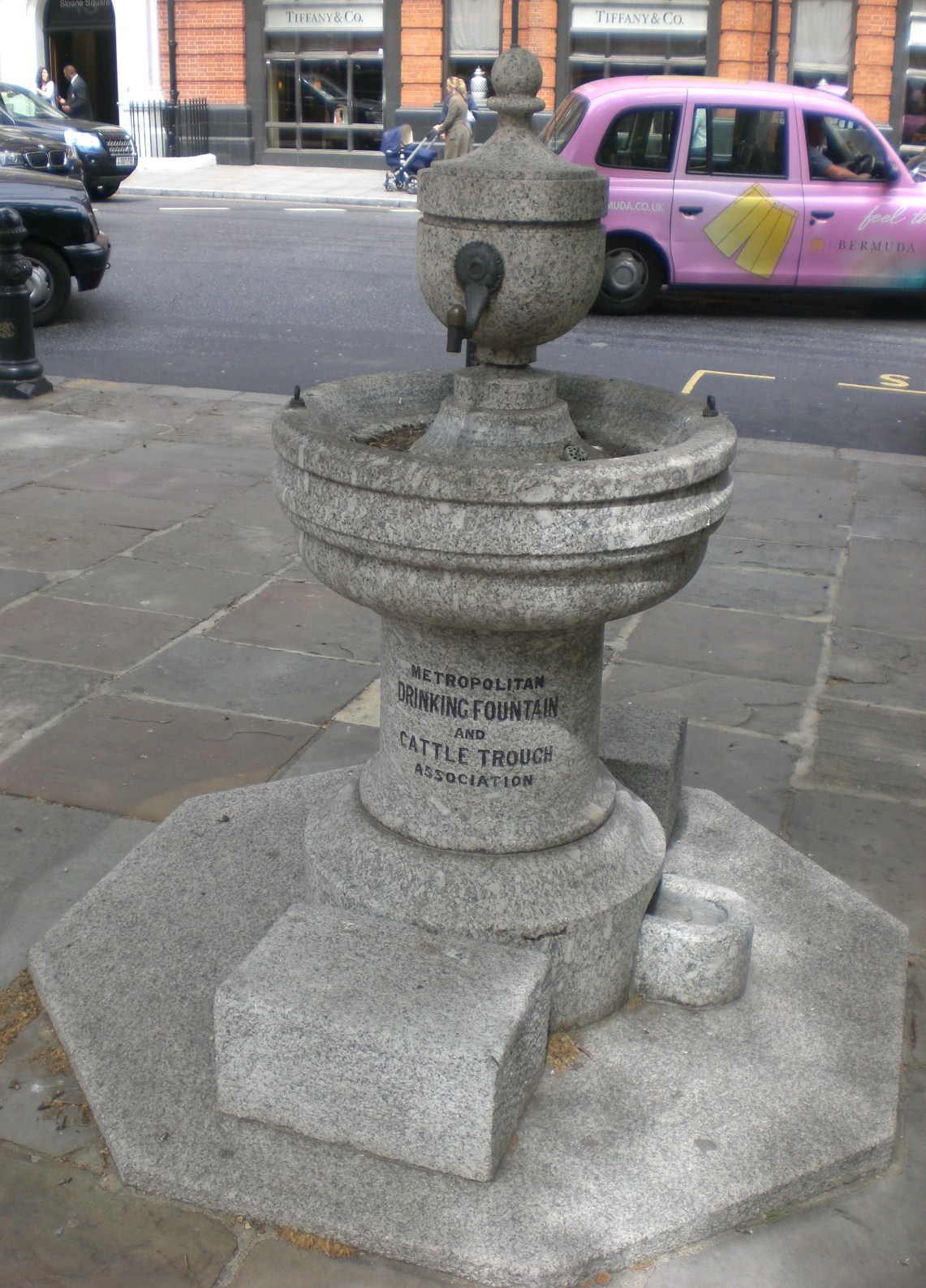
Well I don't know if there's a similar group of individuals out there hunting down horse troughs but it's interesting to me that some of the most visited and searched for items on this blog are those horse-trough related. If someone hasn't already started a definitive list of surviving Metropolitan Association Horse & Cattle Trough's I'm sure it's only a matter of time...

So, always happy to help out, I thought any budding 'trough-ticker' might be interested to hear of this example that has somehow strayed from its original site.
As you can see the move doesn't seem to have done it much harm and it looks happily settled in its new surroundings. The original metal cover is still over the end, it has a couple of shiny red fire buckets hanging off it and the whole thing is actually looking pretty tidy. Best of all this particular trough has ended up in a stable-yard and is constantly surrounded by horses. Sort of an ideal retirement home for it really...
I came across it in the stable yard of the Wimbledon Common Rangers. The current Rangers didn't know of its original position but I'm sure it must have been somewhere on the common itself, otherwise I doubt they'd have been allowed to move it.

The inscription on the end says that it's the gift of 'Three Friends'. I'm sure I've seen this inscription before so I wouldn't be surprised if the three friend's donations are responsible for a number of troughs. It would be interesting to see if they are clustered in one area or spread out evenly throughout London though. Maybe a horse trough expert could fill me in?

Tuesday, 29 September 2009

For Lovers Of Bollards and Lightwells ...

A nice example of a Hayward's Pattern 51 Design F

I'm sure I'm not the only one whose heart quickens at the sight of an intriguing new lightwell, or who has an irresistible urge to gentle caress the cool, worn top of a nicely rounded bollard. Well more 'hoping' than 'sure', but here's some exciting news for those of us already salivating at the prospect of some new, fresh titillation for our jaded palettes.

The first item is from Ian Macky in far-off California. Ian has his own website devoted to glass in all it's many forms and uses and I first came across it when I was looking for some information about the Hayward Brothers of Borough. I was after information on coalholes, but Ian's interest lay mainly with the glass prisms in the lightwells and when I had a look at his site it was obvious I was in the presence of a master. Not only did he have an entire transcription of the history of Hayward Brothers but the levels of detail he was prepared to go to and the fact that I ended up spending ages ferreting around finding out loads of interesting stuff about a subject new to me confirmed Glassian as a top-notch resource. So when he dropped me a line the other week I knew it would be good...
Hi Yelfy, I thought you would be interested to know I've scanned/transcribed my Hayward Brothers pavement lights catalogue and posted it to Glassian. It's here:

It identifies some of your unidentified lights, for example, the last photo of the tile/glass light is HAYWARD'S TILE AND LENS LIGHT pattern #51 (design F), as shown on page 34 (Nice piece! I'm surprised to see one still in such good shape); the one above it with the hexagonal lights appears to be their #3 "Edinburgh" pattern light (see page 16).

There's also a 300DPI scan of the entire catalogue, 150MB in total, as a tarball here:
A Haywards 'Edinburgh' pattern lightwell

A Pavement Lights Catalogue? How good is that? Apart from wondering where on earth you find such a document it opens up whole new layers of possible conversational gambits whilst strolling with friends through town! Many thanks for that Ian. Even if you're not interested in lightwells per se (hard to believe but I'm sure there's a few out there) it's still an interesting read and the Galssian site is well worth a browse on its own.

A Westminster bollard. One of Scott's maybe?

On then to bollards. I put together a posting on bollards over a year ago because I'd noticed a couple of older looking specimens in the Putney/Roehampton area and they reminded me of the old 'cannon' designs you still see now and then. Finding old bollards proved to be a bit of a challenge but I was quite impressed by the quality and styling of the more modern versions so I was pleased to receive an email from Scott Chafer giving some more background detail on both old bollards and the newer types his company manufactures. He also included a number of interesting links to a number of sites dealing with various aspects of foundry work and casting and to cap it all his letter has an excellent opening line...
I stumbled accross your blog whilst perusing the world of street furniture on the Web.
My company manufactures traditional cast iron street furniture, we have been going since 1907 on a site that has a rich history of casting way before this. Records from 1860 show a foundry on this site and indicate that it was far from new even then.
We hold patterns for many of Britains traditional style bollards, the Oxford, City of London, Exeter, Manchester, Blackpool, Liverpool - the list goes on into the hundreds.
We still cast these bollards including a few versions of your beloved Cannon! - Not made from old cannons unfortunately but not too many were, they were mainly cast to look like they were.

Nowadays, all our castings are from 100% recycled materials but we still stick to the high standards of design and quality of the past. As you probably know, much of the modern versions of the traditional street furniture items are imported from China and other such places, whilst there is nothing particularly wrong with these products they can be of questionable quality at times and environmentally are not great - I also consider them to be a bit soul-less.

The importing of Iron from China is quite interesting. Granted, there are comparatively few foundries left in the UK but they are far from rare. (There are 3 within a 25 mile radius of our own - but we are in the industrial North!). People can save money importing their iron but there is so much lost in the process. It is fine if somebody wants 10,000 bollards that all look the same but who wants to live in a world like that?

We like to make things that WILL be there in 100 years (there are some of our bollards around that are that old). There is a good feeling when a post or bollard is supplied and you know that it's really going to last - unless of course an Articulated Truck ploughs it over, but then it has done its job (better the bollard than the human) and that's also the modern world.
It is good to stumble accross people who have a passion for street furniture and traditional products. We still cast everything the old way here - sand mould, made on site and poured as airset castings on the foundry floor. We manufacture modern items too (we are a business after all) but our passion is for cast iron and traditional values.

Please feel free to follow these links - they may be of a little interest:
www.castironbollards.co.uk - our site dedicated to cast iron bollards
www.asfco.co.uk - our main street furniture site
www.wbwhitefoundry.co.uk - just so you can visit our Foundry!
All the best, Scott Chafer
With an attitude to quality like that I can see future bloggers eagerly snapping photos of Scott's bollards in the next century! Good luck to him and his company and long may they prosper.

Thursday, 24 September 2009

Fulham Palace Road

There's a famous old advert that claims 'You're Never Alone With A Strand'. Well I think the same might be the case with a small digital camera. For example if you're about an hour early when meeting a friend in Hammersmith there's no need to hang around the tube station looking slightly shifty and ill at ease, you can grab your camera and take a quick stroll down an interesting looking local road. You still look a bit shifty and passers-by still give you curious looks but at least you get a few photos before diner.

Which is how I ended up having a quick look at Fulham Palace Road from the old Hammersmith Odeon to Lillie Road and back again...

View Larger Map


Fulham Palace Road - One of the most unmissable of signs on this stretch of road is enormous and ornate plaque for the local school and the slightly overshadowed coat of arms is that of the London County Council who presumably financed its building. There's a real sense of civic pride in the whole building - it looks impressive and has towers, weather vanes, good sized windows and all the rest. No expense spared.
There were several of these light wells along the Fulham Palace Road and also down some of the side roads. Although most of them were pretty worn down you could still see on some that they were made by Haywards Brothers. I'd guess that they were later models and they lack a bit of the charm of the more Victorian styling.
Bit of a gothic Ghost Window down Aspenlea Road. It looks as though it's part of a church but when you get above the ground floor it's actually a pretty standard run-of-the-mill house. There's a betting office behind the window now so they probably weren't too worried about matching brick colour or anything...
Greyhound Road has a few interesting bits and pieces including this nice column. What was most interesting though was the partially concealed tiles along its length.
They're pretty much obliterated by paint and cables now, but would probably have looked quite attractive when new.I couldn't resist this sign down Everington Street. Some time ago I had a collection of 'No Parking - Gates In Use 24Hrs' hand-painted signs. Although I don't think I'll necessarily want to do another full posting on the subject I still couldn't let this one slip through the net.
Sadly there weren't any badged manhole covers on the route but this extra-large sized one from Greyhound Road is tidy enough.
An unusual column pediment from Greyhound Road - not so much for the bloke with whiskers but because it has a date incised on it, in this case 1880. I don't think I've seen one dated quite like this before...
One of several building date plaques on the Fulham Palace Road. Quite a nice one too a a fair bit classier than the building it's stuck on.
No intricate shop front mosaics or colourful displays between shop-fronts so if you're looking for interesting tile-work this is about as good as it seems to get. More gentleman's club than Art & Crafts it's better than a bit of pebbledash and a coat of paint!
Keir Hardie House, Fulham Palace Road: This part of London was staunchly working class for the first half of the 20th century so it's no surprise to find a block of flats named after the founder of the Labour Party.
Down the side is an interesting coat of arms which is documented on the Civic Heraldry site as being as being that of Fulham Metropolitan Borough. This wasn't granted until 1927 and Keir Hardie died in 1915 so they didn't rush into the naming of the block. The explanation of the coat of arms is quite interesting though
The wavy blue lines on the white ground of the shield are emblematical of the River Thames, which forms the most important geographical feature of the district, and bounds the borough for a little more than half its area. The crossed swords through a golden mitre on a red saltire are taken from the arms of the See of London, whose Bishops represented by the mitre have held the Manor of Fulham since the end of the seventh century.
The ancient black ship with a white sail bearing a red and a white rose at the centre, refers to the visit of the Danes to Fulham in the year 879. It accentuates the ecclesiastical character of Fulham whose Manor, which included also the parish of Hammersmith, belonged to the Bishops.
The entrance to Brandenburgh House, Fulham Palace Road was lined with these superb Art Deco tiles. I assume they are original but no doubt someone will tell me that they come from a special craft range at B& Q or something. Either way they're very eye-catching
The corner of Distillery Lane has what looks like an interesting façade but close up turns out to be mostly pebble-dashing. The very top is quite interesting though...
...and I wonder how many people living there realise that it's actually called Sussex House? It looks as though it was built in 1908, has another of those blokes with facial hair and has the mysterious initials "WM"Up near the old Hammersmith Odeon two estates face each other across the street. The Peabody and Guinness Trusts are those sort of estates that seem to pop up wherever you live.
Both were the result of philanthropic individuals but Peabody is the senior and larger of the two, being founded by American banker George Peabody in 1862 and having over 20,000 homes on their books. The Guinness Trust had to wait until 1890 to come into being, again as the result of of one man, Edward Guinness. The Guinness Trust operated in both London and Dublin, although the Dublin connection has since ceased. On the battle of the façades it's a bit of a non-contest though. The Guinness has the edge in design, ambience, architecture and elegance although I've no doubt the Peabody flats would more than hold their own internally
Again this is only a short stroll but there's not so many shop related items, such as mosaics, coalholes or ghost signs but the big themes seem to be the early need for social housing in the area, as well the links with labour and schooling. And short stroll it might have been but it set me up nicely for dinner as well...

Monday, 14 September 2009

Pushing Boundaries in Raynes Park

There's an intriguing little plaque on the wall overlooking a disused garage in Raynes Park, that has been teasing me for the last few weeks. Every time I came round the corner of Worple Road I could see it high up on the wall on the one-way part of the road. Too far away to read and (thanks to a very solid plywood fence) too difficult to photograph without a telephoto lens. As luck would have it though, one day last week I had a step-ladder in the back of the car so stopped, shimmied up like some desperate paparazzi and took the photo below.
Well lets be honest, even on top of a ladder at full zoom it's pretty poor, but undaunted I managed to manoeuvre myself into a slightly 'closer' position by scaling the barricades. This produced a much clearer image that I was able to trim to size and finally satisfy my curiosity.
The whole of this flank wall is the property of W. L. Peters 1909

Is it a bit of a let down? I'm not sure really. I suppose that such a marker was always the most likely reason but it does seem a bit on the boring side. That said it could be that Mr Peters is well known to local historians as a major player in the early years of Raynes Park or it might be that he just owned the shop next door but either way it's good to know that his plaque and message has been left alone and even the pebble-dashers didn't obscure it.

Not quite the same story for the second boundary marker I spotted that afternoon which is not only older and more weathered but also seems to have been relocated at some time in its history. This one was on Kingston Road and again was up fairly high - not the best place for an inscription
Not only that but it was quite obvious that the stone was not made for the space available as it stuck out of the end . Having a closer look also shows some new pointing, as well as revealing the fact that this was a Wimbledon/Merton parish boundary marker from what looks like 1866
Sadly most of the inscription is illegible and I presume the original building has long since gone. I've no doubt that it it also used to be situated at a much lower level but at least it's still there doing its job and providing me with a mild diversion at the same time...!

Sunday, 6 September 2009

One short stop in Hampton Wick

Well it's been a slightly frustrating August here in the Faded London international conglomerate publishing offices. Apart from summer holidays, which are always welcome this time of the year, the whole of the production team were struck down with a malfunctioning camera. Or malfunctioning battery to be precise. Still, having traipsed around various shops the Research department eventually ended up with a replacement from eBay which - so far- seems to have done the job. The resulting flurry of pictures have now overwhelmed the Post -Production team, so best start off September with a short one, to ease our way back into things again...

This particular stop happened last Sunday evening. I'd noticed an old drinking fountain on an external wall of Bushey Park and had decided to make a stop on the way back, which I did and very pleased I was to have done so. It was by a gate into the park and nicely visible on google maps
View Larger Map

Getting a bit closer shows it to be a marble drinking trough with some white stone plaque behind it. I don't think it's concrete as I would have thought it would have weathered too quickly. The tap has long since gone but the message is still there.
"August 1889 Erected by Mrs Mary Wilkins of Manor House, Hampton Wick in memory of her son Edward Stanley Wilkins"
The Twickenham Museum has a nice picture of the Manor House and notes that although the house was demolished in 1937 it was selling off land around it from 1897. No doubt there is a story to be told of how losing her eldest son led to the crumbling of the estate as there was no-one left to take over the reins etc. etc. Well that may be a bit fanciful but it'll do me until a more prosaic explanation turns up.
Manor House (pre 1937!)

That was that I thought, but then a strange object caught the corner of my eye. A magnificent and highly ornate tiled memorial of some sort - tucked behind metal railings and on a patch of scrub. You can see it to the right of the Google image.
In fact the monument is to Timothy Bennet, the Shoemaker of Hampton Wick and commemorates a classic case of the 'little man' taking on the big man and winning! Without wishing to spoil the story for you (you can read it all below) Timothy took exception to the local lord enclosing the park and forcing huge detours on the locals so decided to raise the money to take the Lord to law. Realising he was on a looser the Lord gave in and a public right of way was established across the park known as 'Cobblers Walk'. About 150 years later the locals decided this act was worth commemorating with a suitable monument. Presumable the lord and his descendants being long gone it was considered safe to do so by this point...Of course a snappy catch phrase or slogan never goes amiss and "I am unwilling to leave the world worse than I found it" was the phrase associated with Timothy. All credit to him for what he did but I can't help but feel it's not the snappiest or most appropriate epitaph he could have had
Interestingly the Twickenham Museum has some more information (and what a good site it is), this time about Timothy, not least that he wrote a play commemorating the whole episode. In fact their article concludes with the last scene of his play where he gets back his money and his son can marry after all. Huzzah!
Ben. Well, Deborah! The good cause has triumphed!
Mrs. Ben. Thank God! Dear husband.
Mary. Oh, Uncle Timothy, I'm so glad!
Ben. The justices cut short the trial, and declared the Ranger had no case; so the greater part of the hundred pounds has been returned to me.
Mary. Then Jack and Martha can marry after all! And their wedding procession ought to go the very path that you've opened Uncle.
Ben. No, Mary - no unseemly triumph. And say not that I have opened the path: the laws of England did that for us.
The information plaque says he was willing to spend £700 but the play only mentions £100 so I wonder if his munificence was slightly overstated? £100 is a lot for those days but £700 must have been a fortune for a shoemaker!

Still, for a single brief stop that's a fair bit of history.