Wednesday, 17 February 2010

Bits and Bobs on the Uxbridge Road (part 2)

 
Carrying on down the road I eventually started back on the other side toward Shepherds Bush and I wasn't far along when I spotted this intriguing engraving on the kerb. I'd seen similar items before and they had turned out to be benchmarks used by surveyors from the Ordnance Survey so I was immediately thinking if this could possibly be related in any way? Could it be that the 'P' stands for 'Point' (as in 'Height Point' or something?) and it certainly  looks as though the dent above it might be for siting a measuring tool of some type.
  
Could it be that I'm getting led up the wrong path again though and that it in fact has no connection with the OS? It seems to have some age to it if the quality of the lettering is anything to go by. I'll keep looking although any thoughts would be gratefully received...
  
It's been a while since I've spotted any new coalhole manufacturers but I was attracted to this one partly because of the colourful tiles around it. It turns out that the manufacturers are known to me but I'll put it in anyway if only on artistic merit...

Moving on I spotted what looks like a partial restoration of an old shop sign. I say partial because I've a suspicion that the central "Rene's" section of the sign is probably still in use - it certainly looks in pretty good condition. The sections either side of it though are pretty poor in comparison and I suspect that they are only recently uncovered. I assume that they originally read "Tobaccos" and "Stationers".
As the shutters were down I couldn't really see what Rene's sell these days. I wonder if it's still in the same line of business?
This name plaque was on a series of houses pretty much next door to the local church which you might expect to be called St Stephen's. Actually it's called 'St Stephen's and St Thomas' so I didn't know whether the church changed it's name at some point or whether they just decided that it was too much of a mouthful to try to squeeze in on the space available. Some checking back at home though shows that the church of St Stephen, Shepherds Bush, was consecrated by the Bishop of London on April 11th 1850, which means that the villas were not contemporary, but erected 24 years later. I'm not sure when St Thomas was added either, but I suspect it was quite recently, as it was in place by 1964 (which is recent by terms of reference!)
  
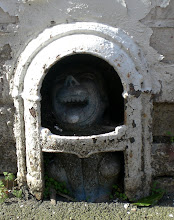
And finally, something for the lovers of basement lighting. A nice example of a combined light and ventilation window that has obviously served its purpose. A slap of paint and it blends in quite nicely with the background. No sign of a makers mark that I could see so I've no idea if it's a Hayward Brothers special...
  
Well for what seemed to be an unpromising re-tread of a street that I'd already visited this was actually quite interesting. If I had to pick a highlight it would have to be the mysterious kerb marking which definitely needs more investigation.

Saturday, 13 February 2010

Bits and Bobs on the Uxbridge Road (part 1)

The Westview Shopping Centre at Shepherds Bush might well be a magnate for post-Christmas shoppers but it doesn't really hold a great deal of attraction for us Faded-Londonites whose idea of a good time is stumbling across a new coal-hole manufacturer. Anyway, I was happy to leave various members of the family to their own devices and to take off for a pleasant stroll out of the temperature-controlled climate of the arcade into the chill wind and icy rain of West London.

I'd been down the same road fairly recently so my expectations with regard to new discoveries weren't particularly high but as soon as I hit the Green I caught sight of this pleasingly decrepit sign.
'Sketty Terrace' - not a very picturesque or attractive name either but certainly one that calls out for a bit of research to try to pinpoint its origins. Not very difficult as it turns out, and anyone from Swansea in South Wales would no doubt have spotted straight away that it's an area in the west of the city. I don't think Shepherds Bush is known for its ex-pat Welsh community so my best bet would be a connection with the developer.

I included the interesting ornament below the sign as they are a common form of decoration and, to be honest, I haven't a clue what they are called. Of course they may not have a proper name at all - and by that I mean an interesting sounding Greek or Roman one - but even if they featured in a builders catalogue they must have had some description or other.  They seem to resemble a sceptre and many, such as the one on Sketty Terrace, have now lost their spike on top. The one pictured  on the left has retained the spike but has been painted white down one side which seems a really daft, (albeit quite common) thing to do . Was anyone ever really pleased with the compromise?                                            
On we go then to the slightly more salubrious looking Pereira Mansions. Not quite as definitive looking this one up as it can refer to a surname, a place in Portugal or a city in Columbia!
Further down the Uxbridge Road turns into The Vale and one of its more interesting sights is a solid old building belonging to a company called Newman Hire Co. Ltd.  It has the air of an old and faded municipal site but if the ghost sign at the very top  is anything to go by was originally the home of Brown Brothers Ltd. I'm familiar with the Australian wine company of the same name, but a bit of research shows that Brown Brothers were a sizeable motor company in the 1930's. I found (literally) a snippet in The Commercial Motor of 1935 that notes "Brown Bothers Trading Results -The report for Brown Brothers Ltd for the year ending January 10 1934 shows a net profit of £71,141"  which doesn't sound too bad. 
 
Well however good it sounds, there must have been lean times around the corner because Brown Brothers moved out, their name was scrubbed and Newman Hire Co Ltd moved in. This new company specialise in props and stage settings, which seems strangely apt as what I enjoy about their facade is its real sense of time and space. That lettering could only really have been erected in the early seventies although it does have some hints of the thirties about it. At a pinch I'd guess it was done at about the time when The Sting and Scott Joplin were all the rage. Which is ironic as it starred Paul Newman. I'm sure there's no connection though...

But the associations don't stop there. The lettering goes around the side as well and the odd missing and lopsided letter remind me of Sunshine Desserts in The Fall & Rise of Reginald Perrin.

The company website shows what looks like an opulent and extravagant set of interiors - it even has a 360 degree virtual tour,  if your computer can take it (mine couldn't and crashed several times before I gave up, but then mine sulks if I ask it to play a cd) Anyway the juxtaposition between the slightly decrepit signage and the elegant interiors is either a well thought-out post modern ironic comment or a recognition that the prop-hire business isn't as profitable as it used to be. Definitely a local landmark though.

Moving on a bit, it's always interesting to see a plaque of some sort up on the walls and those put up by local authorities are more intriguing than most. Slightly obscure local worthies, not-quite so good poets and explorers not quite famous enough to get a coveted blue plaque are the usual subjects and the disc on the corner of Galloway Road is no different. Quite a coincidence this, as George Galloway  has a reputation as a maverick firebrand socialist MP which is similar to Dennis Nowell Pritt, the subject of this Hammersmith & Fulham plaque.

I have to say that his name didn't really strike a chord and the fact that the plaque is both pretty high and very difficult to read suggests that Hammersmith & Fulham weren't really sure how they wanted to remember him either. There's a brief summation of his career on Wikipedia
but here are some of the highlights:

A member of the Labour Party from 1918, he was infamous as a defender of the Soviet Union under Stalin...   Pritt was an MP for Hammersmith North from 1935 to 1940, when he was expelled for defending the Soviet invasion of Finland... Pritt was awarded the 1954 International Stalin Peace Prize and in 1957 became an honorary citizen of Leipzig, which was then in East Germany. He was also awarded the Star of the Volkerfreundschart ( in gold ) in October 1965.
Firebrand socialist and friend of Communism - and all I get is an unreadable plaque!

Coming soon in part 2 - Something odd on the kerb...


Saturday, 6 February 2010

The West Barnes Lane Sink

The perfect camouflage of the West Barnes Sink makes it tricky to spot in fading light 
Coming along West Barnes Lane on my way to Raynes Park the other day I caught sight of a small granite-like sink lurking behind a road name by a double mini-roundabout. As an exercise in sharp-eyed observation this wasn't bad going really as it was all very drab and well camouflaged, but as I went by I just caught sight of a small black plaque on it's side, glinting in the evening sunlight. This was too intriguing for someone of average curiosity and feeble will so later on I stopped by with the camera and had a closer look
From this angle it looks uncannily like a Stonehenge for elves or an obsolete drink  trough for Jack Russells but luckily human sized ankles are saved from a good skinning by virtue of it being sited on a slightly mounded flower bed with a few scrubby plants keeping guard. What can it be? It's obviously 'official' but looks at little unprepossessing...
The plaque is attached at the end and you do have to get down low to read it but the the very fact that I was trying to read it caused some interest. A passer by was trying to figure out what I was doing and I saw them crouch down for a look after I'd moved on, so I suppose in some small way I've helped pass on a little historical curiosity in the area. The succulents are a nice touch though, low maintenance, hardy, drought-tolerant but sadly not all that visible until you get up close. The big question was still had to be answered - what or who was was being commemorated?
How about that, a memorial to R. L. Mackenzie, a local councillor and one-time Mayor of Merton! This was intriguing, how how often do local resident show gratitude to local politicians, especially in taking the time and expense to purchase such a stately and solid item?

I thought I'd see if there was anything about Councillor Mackenzie on the web and was fortunate to come across the Raynes Park and West Barnes Residents' Association newsletter of October 2000 which actually carried a feature on the grand opening itself along with an accompanying picture
The Bob McKenzie Memorial Planter
I am delighted to report that the Bob McKenzie Memorial Planter has been placed and planted on the north side of the intersection of Grand Drive and Westway. This is an ideal location and as central as possible in our ward to remember a friend, colleague, Mayor of Merton, local Councillor, supporter, auditor and adviser to numerous organisations in this area. On behalf of the Association, I would like thank Jean and John Haslam for taking the responsibility for selecting the planter and arranging with the Council for its location in Westway. When it came to planting it, we naturally called upon the Horticultural Section to help us. However after much deliberation they found they could not, or would not. But again our tireless retirees John and Jean Haslam came to our rescue with some ericaceous soil and a few varied heathers which make a handsome display.
So the planter has been there for ten years now. It looks in pretty good condition, although the heathers obviously found the going a bit too tough, making way for the hardier succulents. Curiosity sated it's time to move on...

Saturday, 16 January 2010

The [Not Very] Long And [Only Slightly] Winding Road - Sutton to Carshalton

A few weeks ago I was a man on a mission - and that mission was to obtain a decent picture of a Nuttman Brothers ghost sign I'd seen in Sutton. I'd featured it on the blog some time back but only had a poor quality snap on my daughter's mobile phone to illustrate it and as it was to be deposited in Sam Robert's new national Ghost Signs archive I thought I'd better get a decent image for him.

Taking the photo was just a matter of minutes though, and with a bit of time before a planned rendezvous I was tempted to have 'just a look' down the road. Actually I've done this often enough to realise that deep down I've no intention of stopping after 'just a look' but will keep on going until guilt, shame and embarrassment  finally get the better of me and I beat a hasty retreat to wherever it was I supposed to be in the first place.

As it turned out the road I was travelling was the old route connecting two old Surrey villages that now form part of the London suburbs - Sutton & Carshalton. Sutton is the senior partner presumably because of it's position on a crossroads on a main route into London meant it grew into a small town whilst Carshalton retained a very strong village character with its ponds and attractive High Street. They're not all that far apart which was just as well as time was in short supply

View Larger Map
Setting off the first thing that caught my eye was some very neat tile-work on the front of a corner shop. I always expect shops like this to have been either butchers or dairies, presumably because of the need to have a hygienic, washable surface, but I don't think it's very usual to be advertising the name of the building rather than the business

These were quite elaborate tiles as well with raised three-dimensional lettering. They actually reminded me a bit of the sort of tile-work you see at Underground stations on the Bakerloo line. I think the Poole Pottery had a hand in lots of that sort of work and I wonder if they might have produced this as well?

Carrying on down the road I came across the first of the houses with elaborate construction dates on them. Sutton became an Urban District in 1894 so this house looks as though it was part of that suburban growth spurt sparked by the arrival of the railways 40 years earlier.                                                                                     There was a fair number of interesting villa-style houses along what must have been an important and busy street and another plaque soon caught my eye on the other side of the road
The house itself was of a decent size but it looked fairly plain and a bit austere to me and from a distance it was a bit tricky trying to make out the motto. Of course with a bit of zoom it was easy enough to make out St Mary's Presbytery and what I assume is a picture of St Mary herself in the middle. I was quite interested by this. Although I'd heard the term Presbytery I couldn't hand on heart tell you exactly what it was, or how it related to Presbyterian - as I assumed it did. According to this site  though
Presbyterianism is the form of church government in which elders, both lay people and ministers, govern. The name derives from the Greek word presbuteros, or "elder."
Wikipedia defines a presbytery (as opposed to a Presbyterian) as being  'the name for an area in a church building which is reserved for the clergy' so I assume that the term has evolved from being part of a church reserved for the elders to being another name for a sort of vicarage - although I'm sure there must be some technical differences between them (like being used by different religions or not being for the use of a vicar or something)

It was at about this point that I spotted the interesting old stink-pipe that had it's own posting a few weeks ago. That in itself made the walk worthwhile but there were also few more date plaques down the road. This one was the oldest I spotted at 1870

but there were some more recent ones as well, including this one with the initials of either the builder, architect or first owner I suppose, 'CP' from 1905. I often wonder what the rationale was behind the naming of these sorts of buildings. I've seen some Alma Villas and suchlike which are obviously inspired by notable battles, but I'm sure there were many interesting stories behind the more obscure ones that were probably personal but now lost forever.

This was an interesting door to find though, leading straight out onto a busy road. It looks as though it was last used in a more leisurely age and the ivy creeping through suggests that it's rarely, if ever, used these days.


Honeywood Cottage is presumably related in some way to the larger Honeywood House, a very attractive building next to the ponds which is now Sutton's local museum.


There's a short windy bit in the road as it approaches Carshalton and it takes you past what is now the front gates of St Philomena's Catholic Girls School, reknowned locally for the quality for its car-boot sale and the outcry a few years ago when an 'adult' shop (now gone) opened oppposite the gate.


The entrance is flanked by these two imposing lions, although it does look as though one of them has lost his crown. The school building is the old Carshalton House whose story was described in the 1912 History of the County of Surrey
It was the property of Dr. Radcliffe, physician and M.P., and after his death was bought by Sir John Fellowes, a director of the South Sea Company. It was confiscated after the South Sea catastrophe in 1721, although Fellowes still continued to reside in Carshalton. It subsequently came into the possession of Lord Chancellor Hardwick,  was afterwards used as a military college, and from 1859 to 1893 as a private school, kept by Mr. Bath and Dr. Barrett, who added a wing containing a dormitory. In 1893 it was taken over by the Daughters of the Cross, a Roman Catholic body founded in Liége in 1833.
Dr Radcliffe was not only a Tory MP but a Royal physician but was apparently not always admired locally 
...founder of the Radcliffe Library and Observatory at Oxford, who during his residence at Carshalton made himself exceedingly unpopular with many patients by his candid speeches about their disorders.
Following the road along I soon came to the area of the ponds which I suppose is the heart of Carshalton. Just by a small but busy roandabout I saw an old village-style handpump railed off but obviously still revered. I haven't come across many hand-pumps on my meanderings although I'm sure there must be a few survivors around various old buildings in the City so I was keen to see if there were any makers marks or insignia. Well you can't get much clearer than a large manufacturer's plate slapped right on it's front, so I was happy to go away and see if I could find out anything about the pump-manufacturing firm of J. Tylor & Sons of Highgate Street, London. As usual the internet comes up trumps with an interesting site devoted to village hand-pumps which provided a wealth of information on the subject including an excellent distribution map of remaining hand pumps. (Why so many in Essex I wonder?) The Carshalton pump is mentioned and there's a little potted history of the company as well 
The company was founded in 1778 by John Tylor (b. 1756), who was a Quaker. It became J. Tylor and Sons Ltd in 1892, and in turn was renamed Tylors (Water & Sanitary) Ltd in 1920 and Tylors of London Ltd in 1947. They initially specialised in making tea urns, but by the end of the 19th Century had moved into manufacturing a wide range of hydraulic and sanitary equipment, including fire engines. They existed until 1974, when the company was sold and broken up.

That's all what I suppose you'd call 'quite interesting' but what I think is the really interesting bit about Tylor & Sons are the sons themselves, two very interesting characters with very interesting lives who both seem to have turned their backs on the family manufacturing business for a life in academia.

The first was Edward Burnett Tylor who started working with his father after leaving university early but who then suffered from a bout of tuberculosis. In an effort to restore his health he took a long recuperative break in sunnier climes and found himself in Central America in 1855. On the way he met an ethnologist by the name of Henry Chrisite and that was that as far as pump-manufacturing was concerned. He wrote several highly influential books and Wikipedia sums up the trajectory of his new career
In 1871 Tylor was elected Fellow of the Royal Society, and in 1875 received the honorary degree of Doctor of Civil Laws from the University of Oxford. He was appointed Keeper of the University Museum at Oxford in 1883, and, as well as serving as a lecturer, held the title of the first “Reader in Anthropology” from 1884-1895. In 1896 he became the first Professor of Anthropology at Oxford and he was knighted in 1912.
Well that's quite impressive but his younger brother Alfred Tylor didn't do badly either. He was working on the foundry business from the age of 15 but was apparently fascinated with geology and a love of learning which he put to good use. He was soon a regular contributor to magazines and journals and also became a council member of the Geological Society.

He put this knowledge of geology to good financial use as well, buying the mineral rights to land in the Rhondda Valley in Wales where he created both a thriving colliery and a new settlement called (nodestly) Tylorstown!

I found most of this information about Alfred on a site of Rhondda Valley Place Names but one section really caught my eye.
Alfred Tylor spent the latter years of his life at Carshalton In Surrey where he died In 1884. His interest in the welfare of young people was reflected In his will in which he bequeathed a percentage of his estate to the founding of scholarships for boys and girls in the London area and for the purchase of land for a cricket ground for the use of the youth of Carshalton.
As there are only four surviving Tylor pumps recorded I think it's a fair assumption to make that resumably he was also the kind donor of the village pump!


Last item now and something that has often caught my eye on the way though Carshalton as being slightly incongrous- a mediaeval statue on the side of a fairly modern building.

Actually it turns out that it's a modern work by a sculpture called Dennis Huntley and it was created in 1987. Anne Boleyn was supposed to have stopped off at Carshalton on her way to various 'meetings' with King Henry VIII so I assume the statue was commissioned with that link in mind.

It's nice and definitely adds to the local colour but I find it a little bit on the spooky side and looks as though it would be more at home in an ancesteral tomb rather than on a modern building!


That was about all I had time for but I'd really hardly touched Carshalton proper, so I think I'll be making another trip in the not too distant future to see if there's any more nugets to pick up.

Tuesday, 5 January 2010

The Halez Fax - Kingston


Christmas shopping in Kingston. Not so bad this year as I'd decided it was less of a shopping trip and more an opportunity to visit the German Market for some mulled wine, roast chestnuts and various Germanic treats involving sauerkraut, pork-related meats and fried potatoes with bacon. Only then was I in a suitable state to be gently propelled along the High Street and in an out of shops in search of that elusive 'perfect gift at the right price'. Whilst being led around in my anaesthetised haze one building did manage to catch my eye, namely the Halifax Bank on Eden Street.

It's really the two doorways that I found most interesting, with the sort of ornate decoration that you couldn't really see the modern company investing in. I think it's the use of the blue and gold that makes this stand out and when the colour catches your attention you then start to pick out the other details, like the figures and the bowls of fruit.

The two doorways are superficially very similar but there are a few differences. The doorway on the right has the head of a man on a blue and gold chequered table or altar. There are two neo-classical figures flanking this table reaching across and touching both the head and each other. Just above their hands is an unusual bowl with its centre filled with fruit.

The other doorway, as pictured below, has the same head and chequered table with two different figures in a very similar pose. This time though their hands rest on a depiction of a lamb and flag. The Lamb and Flag might actually be best known to some as a common pub name but is actually a religious icon as noted in Wikipedia
Lamb and Flag: From the Gospel of John (1:29): "Behold the Lamb of God, which taketh away the sins of the world." The Lamb is seen carrying a flag (usually of St. George) and is the symbol of the Knights Templar, the Worshipful Company of Merchant Taylors, and St John's College, Oxford.
Picked out in a sort of mediaeval gothic typeface and placed just above the head is the legend halez.fax which contrasts with the modern Halifax logo to the side. Both doorways are surmounted by a tall window with a further neo-classical head looking down.

I found all of this quite intriguing. Why Halez-Fax? What was the significance of the face and the chequered patterns? Was this common decoration on Halifax Building Society premises or a one off?

Before I went I checked the rest of the building and soon spotted a very large and clear stone giving the name of the builders and the architects. I thought that this might give me a nice starting point as it could possibly show whether or not the architects specialised in this sort of work and whether there might be some other examples listed. And after all with a name like Gale Heath and Sneath how difficult could it be to find anything out about them? Well quite difficult as it turned out...


Googling the company didn't really turn up anything of much interest - a couple of minor buildings and the a legal mention in respect of reclaiming fees, so whatever they were, they don't seem to have been a company of much note or reputation.

The same can't be said about the builders though. F C Minter Ltd seem to have been a significant company in the inter and post war years. According to the Minter family history society's web page  The Minters of North Suffolk
One of William Flood Minter's grandsons was Frederick George Minter who founded the once well-known building company, F G Minter Ltd.
The company seems to have thrived in Putney, SW London and eventually grew into a sizeable concern with contracts all over the UK. Apart from the reams of no-doubt perfectly serviceable buildings, airfields and other civil construction projects they were involved with, their main claim to fame seems to have been based on a couple of significant items of case law that arose as a result of disputed payments, namely F G Minter -v- Welsh Health Technical Services Organisation (1980) and Dawnays Ltd. v FG Minter & Trollope & Colls Ltd. (1971). I have no idea what these disputes were about but they seem to have been very significant and quoted all over the place. On a slightly lighter and more human level F. G. Minter also get a mention in the showbiz autobiography of the great Max Bygraves, 'Stars In My Eyes'
"Because I could make pipe-racks and pastry boards I became a carpenters apprentice...for F. G. Minter... One of my first jobs was helping to put up air-raid shelters at the Crosse and Blackwell's soup factory in Bermondsey, so if anyone remembers taking refuge in those shelters yours truly had a hand in them."
In effect I drew a blank with the dedication stone. The architects seem to have been local and not particularly well known and the builders  were probably treating the job as just one small drop in their construction empire.  On then to the mysterious symbolism and the 'Halez Fax' itself.

I thought I was onto something here almost straight away when I discovered the existence of Halez Fax masonic lodge. One quick look at the masonic arms of the lodge and all the elements were there - the head, lamb and flag, chequered blue and gold, and 'Halez Fax' itself! The lodge came into existence in 1920 and it's tempting to think that there may be a significant masonic connection between the founding of the lodge in Halifax, it's choice of name and of the subsequent building of a Halifax branch in Kingston, especially as it turns out that the head that looks suspiciously like that of Christ is, actually, that of St John the Baptist who also just happens to be on of the patron saints of the masonic order, according to this particular sermon.


But it could be I'm in danger of leaping to exciting but unfounded conclusions. A little further exploration and searching into the history of Halifax itself may have provided an alternative explanation -

This picture is of the old coat of arms of the city of Halifax. Apparently a local legend has it that the head of St John the Baptist, cut off at the request of Salome, somehow ended up buried in the town. The name Halifax itself was supposed to have come from Halez Fax or 'Holy Face', a reflection of which was seen by someone in the local river. The local minster cathedral is also dedicated to St John the Baptist and the lamb and flag are also traditional references to 'the lamb of God' whom John was so reluctant to baptise.  The lamb reference also led St John to eventually become patron of the Guild of Wool Weavers, who were very big in the area in the Middle Ages! The blue and gold chequer however was not a religious symbol but a heraldic device of the Norman Earl de Warren who was a significant landowner in the area.

Of course this might well explain the origins of the symbols and the decoration, but it doesn't really explain why this particular branch was decorated in this way. Could there have been a masonic link with the opening of the new lodge of the same name in Halifax itself? I'm sure many of the senior Halifax Building Society Head Office staff must have been connected with the masons at the time and might even have been members of the new Halifax daughter lodge, created due to the burgeoning interest in masonry in the 1920s. Could it be possible that the decoration of this branch was some sort of low-key commemoration of the founding of this new lodge? Probably not but then again..... you never know. No conclusions on this one then, just some idle speculation and a very attractive shop front.

Monday, 28 December 2009

A Riveting Update On The Wimbledon Common Benchmark

 You might recall a posting in the spring regarding an intriguing white stone near the windmill on Wimbledon Common. I was lucky enough to be able to identify it as being a benchmark used in
surveying as I had spotted something similar the previous week on a kerb in Brentford. Although I was feeling quite pleased with myself at this bit of sleuthery there are, of course, always those out there who know an awful lot more about the subject. Cheltonia left a comment suggested that it was actually a special type of benchmark called a rivet  so I thought some extra checking might be in order.

It didn't take much work before I was reading a site  called The Bench-Mark Database and my eyes were opened to a whole new world of benchmarks and their variants all being meticulously researched and catalogued by a group of dedicated enthusiasts. You might not think this would be much of a problem but it seems that through the history of the Ordnance Survey almost every survey has varied the benchmarks used so there are layers of benchmarks of different vintage and importance.


The database allows you to locate benchmarks in your area so it might be worth having a look to see if there are any unusual examples in your area, and although by no means complete, new ones are always being added. As I couldn't find my Wimbledon one on the database I wrote to the site explaining my query and asking if they could provide any background information on what it might be.  Ian, the site owner, responded with a very full and informative answer which he kindly allowed me to repeat verbatim. The main question then, was what type of benchmark was it?
It's a Ordnance Survey rivet bench mark. The stone wasn't put there by the OS - it's a boundary stone which was already there and the OS used it as a handy location on which to place their bench mark. You quite often find rivets on boundary stones, milestones, and even large boulders. As long is it is not likely to move the OS might have put a bench mark on it.

My database has all the UK fundamental bench marks (about 200), and almost all the flush bracket bench marks (about 21,000). There are about 500,000 lower order bench marks in Britain, such as this rivet, but I don't have anything like full coverage for them. They are just added to the database by users of the site as and when they log them.

Using the windmill in the background of your photograph, I was able to guess at the location of this stone as somewhere in OS grid square TQ2372. I looked at this square in the Ordnance Survey's own database and found the following:

TQ 2303 7250 RIVET TOP BS 20.0M E PUBLIC CAR PARK 52.0321 3 N 1972 - 0.6

Translating this to English: TQ 2303 7250 is the grid reference of the bench mark. The description is "Rivet on top of boundary stone, 20 metres east of the public car park". The rivet was measured at 52.0321 metres above sea level. It's a 3rd-order bench mark. The height above sea-level is relative to the sea level at Newlyn in Cornwall. It was last checked by the OS in 1972. The rivet is about 0.6 metres above ground level.

Looking again at the map near the windmill, I can see both a car park and parish boundary line, and a nearby 50m contour line, which ties up nicely with the description given.

Rivets like this were part of the OS levelling network. Levelling was the process of measuring the hight above sea level of a given point. The surveyors started at Newlyn and moved out across the country measuring from point to point. From this they built a series of very precise bench marks called fundamental bench marks (FBM), such as this one at Croydon with levelling lines running between the FBMs marked every mile or so with a flush bracket (FB) bench mark. The points between the FBs were filled in with lower order bench marks, such as rivets, bolts, and stone cuts.

These days levelling is done using satellites and GPS measurements. Apart from the FBMs, the old levelling network is no longer used or maintained by the OS and the old survey marks are slowly being lost as roads are widened, buildings are demolished etc.
So it looks as though our Wimbledon rivet was one of the lowest order of benchmarks and sited for convenience on top of a pre-existing parish boundary stone and for all intents and purposes became obsolete in about 1972. Not the most earth-shattering of revelations but I have to say that one of the bonuses of noticing it in the first place has been the subsequent discovery of the world of the Ordnance Survey benchmark!

Monday, 21 December 2009

Carshalton And The Mother of All Drain Pressure Relase Pipes

I was taking a short walk between the two 'villages' of Sutton and Carshalton the other week  (and in the process coming across enough bits and pieces to make a future decent posting) and was just going over the railway bridge on Carshalton Road when I caught sight of a most intriguing Drain Pressure Release Pipe in the far distance.

View Larger Map
These pressure release pipes are often referred to as 'Stink Pipes', which seems quite an inappropriate name for something as elegant.  They serve a couple of purposes - firstly as a way of preventing any build up of pressure in underground sewers in the event of a blockage or any other build up of gas, and secondly to make sure that any corrosive hydrogen sulphide gas was vented off. There's a very interesting article on the subject in the Northern Echo with the following explanation from a sewer engineer
"The gas is mainly hydrogen sulphide and it gives that rotten eggs smell, " said Gary Paley, of Darlington, who has been a sewerage engineer for 18 years in Yorkshire. "It usually occurs when sewage is being pumped long distances. It can become septic as it does not travel from A to B quick enough. It can also occur in flat areas where the speed of flow is slower.
"The gas will eat concrete if not dealt with. I remember that the sewer near the racecourse in Thirsk had been almost totally eaten by the gas and just the reinforcing bars from inside the concrete pipes were left. "
Useful utilitarian things then stink pipes, but not an obvious candidate for decorative trappings. I'd seen the same design when a passenger in a car near the Purley Way in Croydon, but this was the first opportunity I'd had of taking a few pictures and having a closer look and it was well worth the effort - even if it was a bit tricky to capture all the details.

There are a couple of things about this pipe that really stand out. The first is the height . Most of the pipes I've documented before have been considerably shorter but this one rises above the street like a needle, possibly up to twice the height of some others. The second eye-catcher is the extraordinarily ornate top fixture comprising a large arrow, a globe with four 'trumpet' funnels and a spiked spire piercing what looks like a crown.

 Of course having had the opportunity to have a look at this one and marvel at its complexities, I then spotted another one down a side road on the journey back to Sutton! As it was a only a few streets away it's tempting to assume it's part of the same pipe run but as it's on the other side of the railway line that would suggest that either the drain is very deep or it's on a parallel, but separate, spur. The second pipe on Weihurst Gardens is, however, also close to the railway line which might suggest the drain and the railway followed the same course.
Then yesterday I was going through Carshalton - on Park Hill Road this time - and spotted a couple more of these pipes along the roadside, One yet again by a (different) railway line with a second pipe (lacking both spike and crown)  just down Park Hill.

View Larger Map
There is very little distance between all four of them which again suggests they were bought and erected at about the same time on the same main drain (or two). If they are venting off of a main drain it might also be the case that it is fairly deep and potentially 'lively', possibly releasing considerable amounts of rather smelly gas. It might therefore require particularly tall pipes in order to disperse it with minimum inconvenience to the locals. Sound reasoning?

One of the big questions I then had was with regard to the purpose of the arrow. Arrows are usually directional in nature, telling people where to go, but the height of these pipes make them impractical if they were for use by the public and there's certainly no indication as to what they might be pointing to. The only logical possibility I can come up with is that they actually point in the direction of the underground main and indicate the flow. When I've nothing better to do I might go back and plot their positions on a map and show the direction that each arrow points in. If they pretty much line up I'll feel vindicated. If they point all over the place I'll have to come up with a new theory

I can't really come up with much to explain the other features though. I assume the ball with four funnels must act as a baffle in some way, allowing the gas to disperse efficiently. Could having an open pipe cause a problem if the wind was from a certain direction? The significance of the crown and spike eludes me completely though, unless the manufacturers had a royal warrant or something equivalent. It seems quite a lot of ornate ironwork for purely decorative purposes but who knows?

This seems to be an explainable addition though, a sleeve with what look like ceramic insulators for either electrical cables or telephone lines, I'm not sure which. Obviously defunct these days, it looks as though they've been given a coat or two of rust resistant paint as well.

Who made these wonderful pipes is the next question. I didn't see anything on the first drainpipe, but the second one I spotted on the corner of Weihurst Gardens has a makers mark on the pipe

W. Macfarlane & Co. Glasgow
 It doesn't take much searching before you realise that these pipes are the produce of one of the greatest of all Victorian iron works, the Saracen Foundry,  the construction of which create the new Glasgow suburb of Possil Park. 

 Walter Macfarlane

Named by Walter himself after a pub by the businesses' original site (The Saracen's Head)  this foundry produced huge amounts of decorative and ornate iron work. Their catalogues were mighty, bound tomes and contained thousands of items of all description relating to ironwork and as they employed the most imaginative designers it's no surprise now that the finished ventilation pipe should be so ornate...Macfarlane's didn't do plain! There's a wealth of information on the company on the Scottish Ironworks site, including a gallery of some marvellous examples of surviving works. The foundry was a huge and inviting target for the Luftwaffe in the second world war and at the same time many examples of their work were lost in the drive to melt iron down for the war effort, but they produced so much and spread it so far around the globe that examples like the Carshalton stink-pipes ensure that the company may be gone, but are unlikely to be forgotten.