Saturday, 16 January 2010

The [Not Very] Long And [Only Slightly] Winding Road - Sutton to Carshalton

A few weeks ago I was a man on a mission - and that mission was to obtain a decent picture of a Nuttman Brothers ghost sign I'd seen in Sutton. I'd featured it on the blog some time back but only had a poor quality snap on my daughter's mobile phone to illustrate it and as it was to be deposited in Sam Robert's new national Ghost Signs archive I thought I'd better get a decent image for him.

Taking the photo was just a matter of minutes though, and with a bit of time before a planned rendezvous I was tempted to have 'just a look' down the road. Actually I've done this often enough to realise that deep down I've no intention of stopping after 'just a look' but will keep on going until guilt, shame and embarrassment  finally get the better of me and I beat a hasty retreat to wherever it was I supposed to be in the first place.

As it turned out the road I was travelling was the old route connecting two old Surrey villages that now form part of the London suburbs - Sutton & Carshalton. Sutton is the senior partner presumably because of it's position on a crossroads on a main route into London meant it grew into a small town whilst Carshalton retained a very strong village character with its ponds and attractive High Street. They're not all that far apart which was just as well as time was in short supply

View Larger Map
Setting off the first thing that caught my eye was some very neat tile-work on the front of a corner shop. I always expect shops like this to have been either butchers or dairies, presumably because of the need to have a hygienic, washable surface, but I don't think it's very usual to be advertising the name of the building rather than the business

These were quite elaborate tiles as well with raised three-dimensional lettering. They actually reminded me a bit of the sort of tile-work you see at Underground stations on the Bakerloo line. I think the Poole Pottery had a hand in lots of that sort of work and I wonder if they might have produced this as well?

Carrying on down the road I came across the first of the houses with elaborate construction dates on them. Sutton became an Urban District in 1894 so this house looks as though it was part of that suburban growth spurt sparked by the arrival of the railways 40 years earlier.                                                                                     There was a fair number of interesting villa-style houses along what must have been an important and busy street and another plaque soon caught my eye on the other side of the road
The house itself was of a decent size but it looked fairly plain and a bit austere to me and from a distance it was a bit tricky trying to make out the motto. Of course with a bit of zoom it was easy enough to make out St Mary's Presbytery and what I assume is a picture of St Mary herself in the middle. I was quite interested by this. Although I'd heard the term Presbytery I couldn't hand on heart tell you exactly what it was, or how it related to Presbyterian - as I assumed it did. According to this site  though
Presbyterianism is the form of church government in which elders, both lay people and ministers, govern. The name derives from the Greek word presbuteros, or "elder."
Wikipedia defines a presbytery (as opposed to a Presbyterian) as being  'the name for an area in a church building which is reserved for the clergy' so I assume that the term has evolved from being part of a church reserved for the elders to being another name for a sort of vicarage - although I'm sure there must be some technical differences between them (like being used by different religions or not being for the use of a vicar or something)

It was at about this point that I spotted the interesting old stink-pipe that had it's own posting a few weeks ago. That in itself made the walk worthwhile but there were also few more date plaques down the road. This one was the oldest I spotted at 1870

but there were some more recent ones as well, including this one with the initials of either the builder, architect or first owner I suppose, 'CP' from 1905. I often wonder what the rationale was behind the naming of these sorts of buildings. I've seen some Alma Villas and suchlike which are obviously inspired by notable battles, but I'm sure there were many interesting stories behind the more obscure ones that were probably personal but now lost forever.

This was an interesting door to find though, leading straight out onto a busy road. It looks as though it was last used in a more leisurely age and the ivy creeping through suggests that it's rarely, if ever, used these days.


Honeywood Cottage is presumably related in some way to the larger Honeywood House, a very attractive building next to the ponds which is now Sutton's local museum.


There's a short windy bit in the road as it approaches Carshalton and it takes you past what is now the front gates of St Philomena's Catholic Girls School, reknowned locally for the quality for its car-boot sale and the outcry a few years ago when an 'adult' shop (now gone) opened oppposite the gate.


The entrance is flanked by these two imposing lions, although it does look as though one of them has lost his crown. The school building is the old Carshalton House whose story was described in the 1912 History of the County of Surrey
It was the property of Dr. Radcliffe, physician and M.P., and after his death was bought by Sir John Fellowes, a director of the South Sea Company. It was confiscated after the South Sea catastrophe in 1721, although Fellowes still continued to reside in Carshalton. It subsequently came into the possession of Lord Chancellor Hardwick,  was afterwards used as a military college, and from 1859 to 1893 as a private school, kept by Mr. Bath and Dr. Barrett, who added a wing containing a dormitory. In 1893 it was taken over by the Daughters of the Cross, a Roman Catholic body founded in LiĆ©ge in 1833.
Dr Radcliffe was not only a Tory MP but a Royal physician but was apparently not always admired locally 
...founder of the Radcliffe Library and Observatory at Oxford, who during his residence at Carshalton made himself exceedingly unpopular with many patients by his candid speeches about their disorders.
Following the road along I soon came to the area of the ponds which I suppose is the heart of Carshalton. Just by a small but busy roandabout I saw an old village-style handpump railed off but obviously still revered. I haven't come across many hand-pumps on my meanderings although I'm sure there must be a few survivors around various old buildings in the City so I was keen to see if there were any makers marks or insignia. Well you can't get much clearer than a large manufacturer's plate slapped right on it's front, so I was happy to go away and see if I could find out anything about the pump-manufacturing firm of J. Tylor & Sons of Highgate Street, London. As usual the internet comes up trumps with an interesting site devoted to village hand-pumps which provided a wealth of information on the subject including an excellent distribution map of remaining hand pumps. (Why so many in Essex I wonder?) The Carshalton pump is mentioned and there's a little potted history of the company as well 
The company was founded in 1778 by John Tylor (b. 1756), who was a Quaker. It became J. Tylor and Sons Ltd in 1892, and in turn was renamed Tylors (Water & Sanitary) Ltd in 1920 and Tylors of London Ltd in 1947. They initially specialised in making tea urns, but by the end of the 19th Century had moved into manufacturing a wide range of hydraulic and sanitary equipment, including fire engines. They existed until 1974, when the company was sold and broken up.

That's all what I suppose you'd call 'quite interesting' but what I think is the really interesting bit about Tylor & Sons are the sons themselves, two very interesting characters with very interesting lives who both seem to have turned their backs on the family manufacturing business for a life in academia.

The first was Edward Burnett Tylor who started working with his father after leaving university early but who then suffered from a bout of tuberculosis. In an effort to restore his health he took a long recuperative break in sunnier climes and found himself in Central America in 1855. On the way he met an ethnologist by the name of Henry Chrisite and that was that as far as pump-manufacturing was concerned. He wrote several highly influential books and Wikipedia sums up the trajectory of his new career
In 1871 Tylor was elected Fellow of the Royal Society, and in 1875 received the honorary degree of Doctor of Civil Laws from the University of Oxford. He was appointed Keeper of the University Museum at Oxford in 1883, and, as well as serving as a lecturer, held the title of the first “Reader in Anthropology” from 1884-1895. In 1896 he became the first Professor of Anthropology at Oxford and he was knighted in 1912.
Well that's quite impressive but his younger brother Alfred Tylor didn't do badly either. He was working on the foundry business from the age of 15 but was apparently fascinated with geology and a love of learning which he put to good use. He was soon a regular contributor to magazines and journals and also became a council member of the Geological Society.

He put this knowledge of geology to good financial use as well, buying the mineral rights to land in the Rhondda Valley in Wales where he created both a thriving colliery and a new settlement called (nodestly) Tylorstown!

I found most of this information about Alfred on a site of Rhondda Valley Place Names but one section really caught my eye.
Alfred Tylor spent the latter years of his life at Carshalton In Surrey where he died In 1884. His interest in the welfare of young people was reflected In his will in which he bequeathed a percentage of his estate to the founding of scholarships for boys and girls in the London area and for the purchase of land for a cricket ground for the use of the youth of Carshalton.
As there are only four surviving Tylor pumps recorded I think it's a fair assumption to make that resumably he was also the kind donor of the village pump!


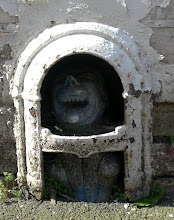
Last item now and something that has often caught my eye on the way though Carshalton as being slightly incongrous- a mediaeval statue on the side of a fairly modern building.

Actually it turns out that it's a modern work by a sculpture called Dennis Huntley and it was created in 1987. Anne Boleyn was supposed to have stopped off at Carshalton on her way to various 'meetings' with King Henry VIII so I assume the statue was commissioned with that link in mind.

It's nice and definitely adds to the local colour but I find it a little bit on the spooky side and looks as though it would be more at home in an ancesteral tomb rather than on a modern building!


That was about all I had time for but I'd really hardly touched Carshalton proper, so I think I'll be making another trip in the not too distant future to see if there's any more nugets to pick up.

Tuesday, 5 January 2010

The Halez Fax - Kingston


Christmas shopping in Kingston. Not so bad this year as I'd decided it was less of a shopping trip and more an opportunity to visit the German Market for some mulled wine, roast chestnuts and various Germanic treats involving sauerkraut, pork-related meats and fried potatoes with bacon. Only then was I in a suitable state to be gently propelled along the High Street and in an out of shops in search of that elusive 'perfect gift at the right price'. Whilst being led around in my anaesthetised haze one building did manage to catch my eye, namely the Halifax Bank on Eden Street.

It's really the two doorways that I found most interesting, with the sort of ornate decoration that you couldn't really see the modern company investing in. I think it's the use of the blue and gold that makes this stand out and when the colour catches your attention you then start to pick out the other details, like the figures and the bowls of fruit.

The two doorways are superficially very similar but there are a few differences. The doorway on the right has the head of a man on a blue and gold chequered table or altar. There are two neo-classical figures flanking this table reaching across and touching both the head and each other. Just above their hands is an unusual bowl with its centre filled with fruit.

The other doorway, as pictured below, has the same head and chequered table with two different figures in a very similar pose. This time though their hands rest on a depiction of a lamb and flag. The Lamb and Flag might actually be best known to some as a common pub name but is actually a religious icon as noted in Wikipedia
Lamb and Flag: From the Gospel of John (1:29): "Behold the Lamb of God, which taketh away the sins of the world." The Lamb is seen carrying a flag (usually of St. George) and is the symbol of the Knights Templar, the Worshipful Company of Merchant Taylors, and St John's College, Oxford.
Picked out in a sort of mediaeval gothic typeface and placed just above the head is the legend halez.fax which contrasts with the modern Halifax logo to the side. Both doorways are surmounted by a tall window with a further neo-classical head looking down.

I found all of this quite intriguing. Why Halez-Fax? What was the significance of the face and the chequered patterns? Was this common decoration on Halifax Building Society premises or a one off?

Before I went I checked the rest of the building and soon spotted a very large and clear stone giving the name of the builders and the architects. I thought that this might give me a nice starting point as it could possibly show whether or not the architects specialised in this sort of work and whether there might be some other examples listed. And after all with a name like Gale Heath and Sneath how difficult could it be to find anything out about them? Well quite difficult as it turned out...


Googling the company didn't really turn up anything of much interest - a couple of minor buildings and the a legal mention in respect of reclaiming fees, so whatever they were, they don't seem to have been a company of much note or reputation.

The same can't be said about the builders though. F C Minter Ltd seem to have been a significant company in the inter and post war years. According to the Minter family history society's web page  The Minters of North Suffolk
One of William Flood Minter's grandsons was Frederick George Minter who founded the once well-known building company, F G Minter Ltd.
The company seems to have thrived in Putney, SW London and eventually grew into a sizeable concern with contracts all over the UK. Apart from the reams of no-doubt perfectly serviceable buildings, airfields and other civil construction projects they were involved with, their main claim to fame seems to have been based on a couple of significant items of case law that arose as a result of disputed payments, namely F G Minter -v- Welsh Health Technical Services Organisation (1980) and Dawnays Ltd. v FG Minter & Trollope & Colls Ltd. (1971). I have no idea what these disputes were about but they seem to have been very significant and quoted all over the place. On a slightly lighter and more human level F. G. Minter also get a mention in the showbiz autobiography of the great Max Bygraves, 'Stars In My Eyes'
"Because I could make pipe-racks and pastry boards I became a carpenters apprentice...for F. G. Minter... One of my first jobs was helping to put up air-raid shelters at the Crosse and Blackwell's soup factory in Bermondsey, so if anyone remembers taking refuge in those shelters yours truly had a hand in them."
In effect I drew a blank with the dedication stone. The architects seem to have been local and not particularly well known and the builders  were probably treating the job as just one small drop in their construction empire.  On then to the mysterious symbolism and the 'Halez Fax' itself.

I thought I was onto something here almost straight away when I discovered the existence of Halez Fax masonic lodge. One quick look at the masonic arms of the lodge and all the elements were there - the head, lamb and flag, chequered blue and gold, and 'Halez Fax' itself! The lodge came into existence in 1920 and it's tempting to think that there may be a significant masonic connection between the founding of the lodge in Halifax, it's choice of name and of the subsequent building of a Halifax branch in Kingston, especially as it turns out that the head that looks suspiciously like that of Christ is, actually, that of St John the Baptist who also just happens to be on of the patron saints of the masonic order, according to this particular sermon.


But it could be I'm in danger of leaping to exciting but unfounded conclusions. A little further exploration and searching into the history of Halifax itself may have provided an alternative explanation -

This picture is of the old coat of arms of the city of Halifax. Apparently a local legend has it that the head of St John the Baptist, cut off at the request of Salome, somehow ended up buried in the town. The name Halifax itself was supposed to have come from Halez Fax or 'Holy Face', a reflection of which was seen by someone in the local river. The local minster cathedral is also dedicated to St John the Baptist and the lamb and flag are also traditional references to 'the lamb of God' whom John was so reluctant to baptise.  The lamb reference also led St John to eventually become patron of the Guild of Wool Weavers, who were very big in the area in the Middle Ages! The blue and gold chequer however was not a religious symbol but a heraldic device of the Norman Earl de Warren who was a significant landowner in the area.

Of course this might well explain the origins of the symbols and the decoration, but it doesn't really explain why this particular branch was decorated in this way. Could there have been a masonic link with the opening of the new lodge of the same name in Halifax itself? I'm sure many of the senior Halifax Building Society Head Office staff must have been connected with the masons at the time and might even have been members of the new Halifax daughter lodge, created due to the burgeoning interest in masonry in the 1920s. Could it be possible that the decoration of this branch was some sort of low-key commemoration of the founding of this new lodge? Probably not but then again..... you never know. No conclusions on this one then, just some idle speculation and a very attractive shop front.

Monday, 28 December 2009

A Riveting Update On The Wimbledon Common Benchmark

 You might recall a posting in the spring regarding an intriguing white stone near the windmill on Wimbledon Common. I was lucky enough to be able to identify it as being a benchmark used in
surveying as I had spotted something similar the previous week on a kerb in Brentford. Although I was feeling quite pleased with myself at this bit of sleuthery there are, of course, always those out there who know an awful lot more about the subject. Cheltonia left a comment suggested that it was actually a special type of benchmark called a rivet  so I thought some extra checking might be in order.

It didn't take much work before I was reading a site  called The Bench-Mark Database and my eyes were opened to a whole new world of benchmarks and their variants all being meticulously researched and catalogued by a group of dedicated enthusiasts. You might not think this would be much of a problem but it seems that through the history of the Ordnance Survey almost every survey has varied the benchmarks used so there are layers of benchmarks of different vintage and importance.


The database allows you to locate benchmarks in your area so it might be worth having a look to see if there are any unusual examples in your area, and although by no means complete, new ones are always being added. As I couldn't find my Wimbledon one on the database I wrote to the site explaining my query and asking if they could provide any background information on what it might be.  Ian, the site owner, responded with a very full and informative answer which he kindly allowed me to repeat verbatim. The main question then, was what type of benchmark was it?
It's a Ordnance Survey rivet bench mark. The stone wasn't put there by the OS - it's a boundary stone which was already there and the OS used it as a handy location on which to place their bench mark. You quite often find rivets on boundary stones, milestones, and even large boulders. As long is it is not likely to move the OS might have put a bench mark on it.

My database has all the UK fundamental bench marks (about 200), and almost all the flush bracket bench marks (about 21,000). There are about 500,000 lower order bench marks in Britain, such as this rivet, but I don't have anything like full coverage for them. They are just added to the database by users of the site as and when they log them.

Using the windmill in the background of your photograph, I was able to guess at the location of this stone as somewhere in OS grid square TQ2372. I looked at this square in the Ordnance Survey's own database and found the following:

TQ 2303 7250 RIVET TOP BS 20.0M E PUBLIC CAR PARK 52.0321 3 N 1972 - 0.6

Translating this to English: TQ 2303 7250 is the grid reference of the bench mark. The description is "Rivet on top of boundary stone, 20 metres east of the public car park". The rivet was measured at 52.0321 metres above sea level. It's a 3rd-order bench mark. The height above sea-level is relative to the sea level at Newlyn in Cornwall. It was last checked by the OS in 1972. The rivet is about 0.6 metres above ground level.

Looking again at the map near the windmill, I can see both a car park and parish boundary line, and a nearby 50m contour line, which ties up nicely with the description given.

Rivets like this were part of the OS levelling network. Levelling was the process of measuring the hight above sea level of a given point. The surveyors started at Newlyn and moved out across the country measuring from point to point. From this they built a series of very precise bench marks called fundamental bench marks (FBM), such as this one at Croydon with levelling lines running between the FBMs marked every mile or so with a flush bracket (FB) bench mark. The points between the FBs were filled in with lower order bench marks, such as rivets, bolts, and stone cuts.

These days levelling is done using satellites and GPS measurements. Apart from the FBMs, the old levelling network is no longer used or maintained by the OS and the old survey marks are slowly being lost as roads are widened, buildings are demolished etc.
So it looks as though our Wimbledon rivet was one of the lowest order of benchmarks and sited for convenience on top of a pre-existing parish boundary stone and for all intents and purposes became obsolete in about 1972. Not the most earth-shattering of revelations but I have to say that one of the bonuses of noticing it in the first place has been the subsequent discovery of the world of the Ordnance Survey benchmark!

Monday, 21 December 2009

Carshalton And The Mother of All Drain Pressure Relase Pipes

I was taking a short walk between the two 'villages' of Sutton and Carshalton the other week  (and in the process coming across enough bits and pieces to make a future decent posting) and was just going over the railway bridge on Carshalton Road when I caught sight of a most intriguing Drain Pressure Release Pipe in the far distance.

View Larger Map
These pressure release pipes are often referred to as 'Stink Pipes', which seems quite an inappropriate name for something as elegant.  They serve a couple of purposes - firstly as a way of preventing any build up of pressure in underground sewers in the event of a blockage or any other build up of gas, and secondly to make sure that any corrosive hydrogen sulphide gas was vented off. There's a very interesting article on the subject in the Northern Echo with the following explanation from a sewer engineer
"The gas is mainly hydrogen sulphide and it gives that rotten eggs smell, " said Gary Paley, of Darlington, who has been a sewerage engineer for 18 years in Yorkshire. "It usually occurs when sewage is being pumped long distances. It can become septic as it does not travel from A to B quick enough. It can also occur in flat areas where the speed of flow is slower.
"The gas will eat concrete if not dealt with. I remember that the sewer near the racecourse in Thirsk had been almost totally eaten by the gas and just the reinforcing bars from inside the concrete pipes were left. "
Useful utilitarian things then stink pipes, but not an obvious candidate for decorative trappings. I'd seen the same design when a passenger in a car near the Purley Way in Croydon, but this was the first opportunity I'd had of taking a few pictures and having a closer look and it was well worth the effort - even if it was a bit tricky to capture all the details.

There are a couple of things about this pipe that really stand out. The first is the height . Most of the pipes I've documented before have been considerably shorter but this one rises above the street like a needle, possibly up to twice the height of some others. The second eye-catcher is the extraordinarily ornate top fixture comprising a large arrow, a globe with four 'trumpet' funnels and a spiked spire piercing what looks like a crown.

 Of course having had the opportunity to have a look at this one and marvel at its complexities, I then spotted another one down a side road on the journey back to Sutton! As it was a only a few streets away it's tempting to assume it's part of the same pipe run but as it's on the other side of the railway line that would suggest that either the drain is very deep or it's on a parallel, but separate, spur. The second pipe on Weihurst Gardens is, however, also close to the railway line which might suggest the drain and the railway followed the same course.
Then yesterday I was going through Carshalton - on Park Hill Road this time - and spotted a couple more of these pipes along the roadside, One yet again by a (different) railway line with a second pipe (lacking both spike and crown)  just down Park Hill.

View Larger Map
There is very little distance between all four of them which again suggests they were bought and erected at about the same time on the same main drain (or two). If they are venting off of a main drain it might also be the case that it is fairly deep and potentially 'lively', possibly releasing considerable amounts of rather smelly gas. It might therefore require particularly tall pipes in order to disperse it with minimum inconvenience to the locals. Sound reasoning?

One of the big questions I then had was with regard to the purpose of the arrow. Arrows are usually directional in nature, telling people where to go, but the height of these pipes make them impractical if they were for use by the public and there's certainly no indication as to what they might be pointing to. The only logical possibility I can come up with is that they actually point in the direction of the underground main and indicate the flow. When I've nothing better to do I might go back and plot their positions on a map and show the direction that each arrow points in. If they pretty much line up I'll feel vindicated. If they point all over the place I'll have to come up with a new theory

I can't really come up with much to explain the other features though. I assume the ball with four funnels must act as a baffle in some way, allowing the gas to disperse efficiently. Could having an open pipe cause a problem if the wind was from a certain direction? The significance of the crown and spike eludes me completely though, unless the manufacturers had a royal warrant or something equivalent. It seems quite a lot of ornate ironwork for purely decorative purposes but who knows?

This seems to be an explainable addition though, a sleeve with what look like ceramic insulators for either electrical cables or telephone lines, I'm not sure which. Obviously defunct these days, it looks as though they've been given a coat or two of rust resistant paint as well.

Who made these wonderful pipes is the next question. I didn't see anything on the first drainpipe, but the second one I spotted on the corner of Weihurst Gardens has a makers mark on the pipe

W. Macfarlane & Co. Glasgow
 It doesn't take much searching before you realise that these pipes are the produce of one of the greatest of all Victorian iron works, the Saracen Foundry,  the construction of which create the new Glasgow suburb of Possil Park. 

 Walter Macfarlane

Named by Walter himself after a pub by the businesses' original site (The Saracen's Head)  this foundry produced huge amounts of decorative and ornate iron work. Their catalogues were mighty, bound tomes and contained thousands of items of all description relating to ironwork and as they employed the most imaginative designers it's no surprise now that the finished ventilation pipe should be so ornate...Macfarlane's didn't do plain! There's a wealth of information on the company on the Scottish Ironworks site, including a gallery of some marvellous examples of surviving works. The foundry was a huge and inviting target for the Luftwaffe in the second world war and at the same time many examples of their work were lost in the drive to melt iron down for the war effort, but they produced so much and spread it so far around the globe that examples like the Carshalton stink-pipes ensure that the company may be gone, but are unlikely to be forgotten.

Thursday, 10 December 2009

When The Full Monty Goes for a Burton*


"Montague Burton - The Tailor of Taste"  ... what an excellent strap-line! I think it's hard these days for many of us to realise just how big a company Burton's were in the 20th century. One of the FTSE 100 company's Burtons were, for a long time, the biggest range of tailors in the world. 

The crest pictured above is from a store at Croydon, and on it is the claim that the company was founded in 1900 but Montague seems to be stretching the truth a little on that one. It's more like the day he landed in Britain from Lithuania with £100 in his pocket to seek his fortune, but I guess from his point of view it's a pretty valid claim and he soon set about making the dream of a fortune a reality. Of course Montague Burton wasn't his real name either - he started out as Meshe David Osinsky, tried Maurice Burton for a while but then finally settled on the slightly grander Montague Maurice Burton. He married Sophia Marks in 1909 and they later went on to have four children, Barbara, Stanley, Arnold and Raymond.There is a fascinating account of his story on the Working Lives Archive in a section dealing with the lives of immigrant workers to the country. It is also well illustrated with photos such as the one below.

Arnold, Barbara, Stanley & Raymond - 1919

And it's really his wife and children that are the reason for this particular entry, rather than the much celebrated Montague. By 1929 the Burton website claims he had over 400 shops and premises and by the time of Montague's death in 1952 there were many more. It seems that many of these stores were ceremonially opened by a member of the family - if not Montague himself, then his wife or one of his children, and the stores were often graced with an inscription to commemorate the occasion. I am sure many of these inscriptions still exist - pound to a penny there's one underneath the Croydon store pictured above - but I have recently stumbled across three examples and expect (now that I'm looking out for them ) to find a few more.

The stone is quite easy to spot, partly through its uniformity from site to site and apparently Scottish granite, according to the author J. Foster Fraser

Every Montague Burton shop has the same outward appearance, both in its window dressing and in the name of the firm uniformly presented in bronze lettering on the marble. The exterior stonework is always of emerald pearl granite with shafts of Scotch grey granite. The interior fittings of oak and gun-metal quiet and dignified are the same at every branch.

First up is this example from Richmond that follows what is obviously a house style for such an inscription. It's also the oldest of the three being inscribed in 1928 and apparently unveiled by his son Stanley. Stanley had been born in 1914 which made him 14 when he cut the ribbon on this particular store,  so not the middle-aged captain of retail you might expect to be wheeled out for such an event! Stanley eventually served in the RAF during the war and later, along with his brothers, became a director of Burtons in 1945. He died in 1991, but not before following another family tradition and setting up a charitable trust. The Independent newspaper made this brief mention of his will in 1992.
Mr Stanley Howard Burton, of Harrogate, North Yorkshire, left estate valued at pounds 4,040,016 net.
You can also make an appointment at the Leeds museum to have the pleasure in examining Stanley's travelling case or you could have a look at the Audrey and Stanley Burton Gallery at the University of Leeds.

Oh dear. Seems a little disrespectful to Arnold but his inscription has obviously become a well-regarded stopping point for the dogs of Rosehill near Sutton. Ten years after Stanley's inscription, Burton's must have been one of the original shops in the area to help service the new and mighty St. Helier Estate, one of the largest housing estate in Europe at the time.

Arnold and his twin Raymond were born in 1917 so he was a more respectable 21 years of age at the time of the dedication. Arnold, like his brothers, also went into the family business and was able to indulge his passion for fast cars as Mel Reuben of Leeds recalled on a Leeds website
Arnold Burton who loved fast sports cars, purchased a top of the range French sports car. The car was being cleaned and valeted for his collection in the washing bay,in my wisdom I decided to take a short cut on the shop bike. Unfortunately I skidded on the wet floor and crashed the bike into the car and badly scratched the car. This was just a hour before Arnold Burton was collecting it.Subsequently I was suspended for the day and sacked the next day
Arnold also went into the motor business with racing driver John Woolfe. This love of fast cars never left Arnold with tragic consequences as he was recently involved in a crash that left two people dead.  Arnold has also set up his own charitable trust with a focus on Jewish and Yorkshire-related works .


And finally, the 'never to be referred to by her own name' inscription of Lady Montague Burton nee Sophia Marks and daughter of a furniture dealer(rather than the Marks of Marks and Spencer). This example of her presence is on the now-pedestrianised Sutton High Street getting toward Sutton Station. She died in 1957 and was buried with her husband in Leeds. However they were both eventually removed and re-interred in a new Jewish cemetery in Harrowgate in 1964.

I hope to find some inscriptions from Barbara and Raymond as well as from Montague himself in order to complete the set and with over 600 potential sites I'm sure it won't take too long.


*When The Full Monty Goes for a Burton are two sayings linked to the company. A 'Full Monty' was a cut-price all in one set of clothing suitable for de-mobbed servicemen  and Gone for a Burton - a euphemism for being killed - is allegedly based on the same premise, 
 "It is a reference in some way to the suits made by Montague Burton. Military personnel were given a Burton's suit on demobilization, so anyone who was absent, either by being killed or after demobilization, could have been said to have 'gone for a burton'"

Friday, 4 December 2009

"Just another brick in the wall" (Fire-brick that is...)


You wouldn't  think there was much mileage in a garden wall really. Not a great deal to get the old grey matter working, pique the curiosity or get the juices flowing. It's interesting though how even the most unlikely of sources can pose a conundrum. I suppose landscape detectives can read a certain amount into rural walls - the materials used for example would reflect the cheapest and most easily available resource, whether it be flint, granite, slate or limestone. You can also tell about regional variations in building techniques or dry stone walling which might be instructive. In cities though most garden walls are made of the ubiquitous brick that could have been shipped in from almost anywhere. But what if the wall is made of a completely unexpected and unusual material? Presumably one available locally and cheaper than the cheapest brick. Can that still provide a window on the past like its country cousins?

Take this wall in Abbey Road, South Wimbledon for instance. I've walked past it many times and always thought it to be a not particularly attractive but utilitarian bit of walling. A bit on the grim and foreboding side but doing its job. It runs the length of about ten houses for the end of a whole block, so is obviously not the work of a single house-owner doing a spot of DIY.  
I'd have to be honest and say it's not the sort of wall you'd linger over or think particularly worthy of closer inspection....until that is (cue the dramatic music) you went and had a closer look! Straight away the first thing you'd notice was the materials that were being used were all very irregular and not the most obvious choice when building a wall.


 The second thing that stands out is that a large number of these irregularly shaped items seem to be man-made and obviously broken pieces of something larger, such as the central slab in the section above.

In fact the more I looked at it the more obvious it was that the rough and irregular dressing of the stones was due to the fact that most of them were covered in a thick layer of slag and not the usual sort of garden walling found at B&Q!

Mixed in amongst the slag covered pots were some bricks, masonry, clinker and seemingly random 'lumps' of indeterminate origin. Definitely not the sort of industrial mix you'd expect to find on a (relatively) quite Merton back street.

The obvious question then is where it came from and how it came to be used in such a manner? As you can see from the buildings their design doesn't suggest that the wall was built at the same time and it actually seems to be a much later addition. 
 
My first thought was that there might be a railway connection as the side of Abbey Road leads into Station Road - a name that seems a little odd at first when you think that South Wimbledon tube is about half a mile away. However I knew that there was a much more direct railway link that was still around up until the early 80s.  This was a short branch line - mainly devoted to freight - that ran along what is now Merantun Way.
You can see the route on the google satellite map. The old station was about where the roundabout is now situated and Station Road was originally about twice as long as it is now.

View Larger Map

Could they have come from the steam engines furnaces?  The fact that they were encrusted onto clay suggested that was unlikely and I don't believe that steam engines generated that sort of heat, so that was one initial (not so) bright idea out of the window.

Then I had a bit of luck. Working my way along the wall I found a couple of bits of clay that had a manufacturers mark on them.  

B. GIBBONS JNR.  LTD  -  NR. STOURBRIDGE 

I had no idea whether this was significant or not but it was the only lead I had so I made a note of the name and went off for a bit of investigating.                                                           It was soon apparent that the Gibbons family seem to have been significant players in the mining and metalworking businesses during the Industrial Revolution. I found records of leases going back to the1830's which describe Benjamin Gibbons and his brother John as being mine-owners and iron-masters.
However, they really seem to have hit the jackpot with their mining of fire clay which initially almost seems to have been regarded as a by-product of the coal industry itself. Its real worth was soon realised and this extract from Black Country Industries by Bev Parker shows how well regarded the Gibbons fire clay was
In this, the Stourbridge and Brierley Hill district, a very extensive business is carried on in the manufacture of fire-bricks of all kinds, used in the construction and relining of blast furnaces, puddling furnaces, cupolas, and air furnaces. The fire-clay deposits here are reputed the best in England, being fashioned into melting pots and gas-making retorts, which fetch high prices; these bricks are exported largely, and are highly prized in all parts of the world, particularly the foreign settlements of the British Empire, the general opinion being that they resist the highest temperatures in smelting furnaces of any others which have yet been produced. Perhaps Ruffords, Mrs. Emily Gibbons, and Pearson and Harrisons, make the best quality. Mrs. Gibbons, relict of the late Benjamin Gibbons, Esq., the well-known ironmaster of the Millfields furnaces, we are informed by Mr. Jones, of the Commercial Gas Works, here stands unrivalled for the manufacture of these Gas Retorts.
Emily had taken over the fire brick side of the company with great gusto after the death of her husband Benjamin and she seems to have been a rare case at the time of highly successful woman running an industrial company. On her retirement in 1880 she was eventually handed it over to her two sons who kept the name going into the 20th century.


I was also very fortunate to come across a newspaper article that not only went into the history of the company, but that also gave some background to fireclay itself. The article was grandly entitled When Gibbons fireclay works of Gornal led the world in gas retorts   and it points out that
...from the earliest times the fireclay extracted from the bowels of the Black Country was considered to be of the highest quality. Usually lying beneath the coal seam, the extraction of fireclay occurred within a relatively small area, centred on Lye, Cradley, Amblecote, Brierley Hill, Pensnett and Gornal. It was shaped into articles known as refractories, of which the most familiar kind is the firebrick, and it was noted that Black Country refractories could withstand the very highest temperatures without cracking. When the Industrial Revolution dawned, the Black Country fireclay fields really came into their own, and by the late nineteenth century there was barely a blast furnace, glass cone, pottery kiln, steel works, iron foundry, coal mine, or chemical plant that did not use refractories of one type or another made in the Black Country. Almost every industry in the Empire depended on our brickyard chaps and wenches, who by 1864 were making 30 million firebricks alone every year.
 
So assuming that our slag encrusted pottery was actually firebrick it suggest it might well have come from a blast furnace, iron foundry, glass cone, pottery kiln or chemical plant, which narrows it down fractionally (I'm ruling out the coal mine and  steel works as I'm pretty sure they would have been noticed in South Wimbledon)

But what are these gas retorts that everyone praises so highly? Not being a chemist or an engineer I had to dig around a bit further to find out and they seem in essence to have been used in the manufacture of gas from coal (I believe this was the basis of the old 'Town Gas' before we all went over to the North Sea variety). Retorts were large pottery tubes (described as looking like torpedoes) in which coal was heated at very high temperatures and which eventually produced coal tar, gas and various other by-products. Could these bits of pottery be the remains of broken retorts then?

The possible presence of retorts had me thinking that there might have been a small gas works on the site, using the coal coming in from the railway to make gas for local consumption. As it turned out there was indeed a power station on the line for whom the coal was intended. Sadly for me it turned out to be a large power station in Croydon, not a little gas-house in  South Wimbledon!  Things were looking a bit grim on the detective side when I found myself straying off the path somewhat. In my researching I had discovered that on the other side of our lost railway line was the site of an equally lost factory - the Line Bothers 'Tri-Ang' Toy Factory complex (There were three Lines brothers, and as everyone knows three lines joined together make a tri-angle!). Not only that, in the thirties it was regarded as the largest toy factory in the world and during the second world war had been the worlds largest manufacturer of the Mk III Sten submachine-gun! This is a fascinating company with a fascinating history of its own but what grabbed my attention was the fact that a commentator noted it was one of only a couple of manufacturing sites large enough to have its own private siding. You can get an idea of the size of the site in the picture below. The railway is to the left of the factory, converging at the top left of the. site with the Abbey Railway station.
(Addendum: This Pathe newsreel shows toy testing in Morden in 1951 and by the type of toys being tested I would be pretty sure that it was filmed at the Tri-Ang factory itself)

TOY TESTING

Fascinating as this was, what really caught my attention was one of the other site important enough to have its own siding was The Eyre Smelting Co. Ltd.  Well if I was looking for a local site that might be interested in using fireclay, this was surely it!

Grace's Guides have an interesting illustration of  an Eyre Smelting Works catalogue which give some indication of the range of metallurgical products they were involved with.

Some further searching led to a railway site with photos of the old line, including picture number S03 a 1968 photograph of a derelict Merton Abbey station with the chimneys of the Eyre Smelting works in the background.  I haven't as yet found a potted history of the company - and for all I know it may still exist in some shape or form somewhere - but there are occasional references to the works on the internet, including the odd publication, advertisements in aviation trade magazines, notice of the production of a commemorative calender for the Festival of Britain and, most intriguing of all - its role in role in the scrap business.  For those who are nostalgic for the golden age of flight the Eyre Smelting Works seems to have been the last resting place for a huge number of decommissioned aircraft, including Spitfires, Spitefuls, Meteors, Vampires and all manner of other post war planes whose eventual destinations have been logged by enthusiasts. But it wasn't only British and American planes that succumbed to the Eyre Eorks furnaces.  Immediately after the war a large number of German aircraft were flown to Britain for testing and evaluation before suffering in the harsh winter of 1949
Many of the aircraft were overturned in the gales, and others suffered from falling trees, and shortly after this, the wholesale scrapping began... After all useful pieces and large metal areas had been removed, the mortal remains were buried in twenty feet deep holes where they remain to this day. This burial process was quite common with another pit being sited out beyond Brize Norton village in farmland, to accommodate the remains of aircraft that had been stored in dispersed sites.
The last recorded "movement" of a German aircraft took place on the 16th of December 1948, when Siebel Si 204D AM 46 was sold to the Eyre Smelting Co.
I haven't found exactly when the Eyre Smelting works closed down but the railways stopped in the mid-70s and Merantun Way was built in the early 90s. My guess would be that the smelting works had melted down its last jet-fighter within a few years of  the 1968 picture and had then been demolished itself. Its furnaces and fireclay had then been smashed and broken up, revealing its lining of petrified slag and clinker.  Quite who the enterprising builder was who spotted a convenient use for the waste I doubt I'll ever find out but you have to admire their parsimony and I wonder if any of the occupants of the houses realise that part of their garden wall may once have been flying above them during the Battle of Britain?


All this is conjecture and guesswork of course and quite possibly totally inaccurate, so I'm looking forward to hearing from anyone who can provide a bit more information about the Eyre Smelting Works and the unlikely South Wimbledon garden wall. I hadn't realised what a historical journey I was setting out on when I first thought to have a closer look at it but it's amazing where a bit of old clinker can take you!

Thursday, 26 November 2009

'The Look Out' - Kingston Road, South Wimbledon

There's a sadly derelict  (or at least semi-decrepit) building in South Wimbledon that looks as though it has an interesting story to tell. The trouble is I'm having some problems pinpointing exactly what that story might be!

The building in question sits on the corner of Kingston Road and Wilton Crescent in South Wimbledon and at first glance looks like a fairly impressive, but fairly typical Victorian house


View Larger Map

As you can see from the Google view, the house is boarded up and doesn't seem to have had anyone involved with it for some time

It's only when you go round the side of the building into Wilton Crescent that you can see what it was that caught my eye - two rather large, gleaming white plaques on the chimney stack. They were so bright that at first I thought they might have been added at a later date or that they might have been infills of old windows, but of course being built into the chimney would make the chances of them being anything else than what they are remote indeed.

 It was the size and the  - let's face it - slightly ostentatious look of these plaques that made me think that whoever built or commissioned such a building must have had a bit swagger and self-confidence about them and might just have a bit of a tale to tell. What was also apparent from the side view was that in a heavily residential area, this building had somehow acquired what looked like a small factory unit tagged on at the rear, best seen from the Google satellite view of the area. When had that been built and for what reason?


All very intriguing then and definitely worth  a bit of a scratch around on the internet to see if anything interesting came up.

As a start, the date on the top plaque was quite interesting as it shows the building was constructed about ten or more years before the building boom really took off in this particular area. Due to its position this was not really surprising as it was built facing  the main road  to Kingston whereas much of the later development took place in the newly laid out streets behind the building

  The larger sign beneath the date plaque is even more interesting as it depicts the name of the building in the form of a three -part scroll in front of a flowering plant.

The building was evidently called The Look Out but I have to say finding any evidence that it was ever actually referred to or called by the name is proving a little difficult. I was also wondering if there was any particular reason why it should be connected with a flowering plant and an unusual two-handled, three legged flower pot - other than for decorative purposes?

Probably not but I couldn't help but be reminded of the three-legged pot famously connected with ironmongers, as depicted in this particular coal hole cover depicting the dog and the three-legged pot

A casual enquiry of a local historian didn't throw up any suggestion as to any great history or famous owners but there is a strong link with Christian organizations and charities up until almost the present day, and the thought did cross my mind as to whether The Look Out might have a similar origin to the Jehovah's Witness magazine The Watchtower . 


On reflection I don't believe this to be the case as it's more likely to be down to the design of the building itself, as it has large flat balconies both to the front and the rear. These balconies are on the roof and at the time of construction would have had commanding views over the surrounding fields

You can see the balustrades on the front view and these were duplicated to the rear of the roof. Lots of room up there for a barbecue or a small tea party!

I haven't as yet found out much about the buildings early years but it does seem to have been owned by an organization called the St Christopher's Fellowship for some considerable time, possibly going back to the Second World War. The Fellowship was originally a Victorian charity and the the work of three friends who sought to improve the lot of young working boys. Their website has a nice potted history and mentions that one of the three founders, Arthur Kinnaird, was an early footballing 'superstar'! A quick look on Google shows that he was a little more than that and amongst many other fascinating remarks I particularly enjoyed the fact that he celebrated his fifth Cup Final victory by standing on his head in front of the pavilion as well as his enthusiasm for a bit of 'manly' shin-hacking!

Kinnaird played for both the Wanderers - a highly influential early team based in Battersea Park - and the Old Etonians but what the potted history misses was the fact that one of the other founders Quintin Hogg - was not only a merchant, philanthropist and grandparent of our own Lord Hailsham, but was also a player for the Wanderers himself and actually bettered Kinnaird in representing Scotland twice to Kinnaird's single appearance (although I'm sure the fact he was one of those responsible for organizing the first ever match had no bearing on the matter!) The third member of the triumverate, Thomas Pelham, doesn't seem to have played himself but was certainly influential in establishing youth clubs for boys and was a university friend of the others.
Lord Kinnaird ready for a game. Watch out shins!

As an aside, Kinnaird and Hogg are also discussed in a fascinate book on the Victorian origins of football called Those Feet - A Sensual History of English Football by David Winner who notes how they were both heavily involved in the social purity movement including being vice-president of the National Vigilance Association, a fairly extreme and aggressive group involved in '...campaigns and prosecutions against 'indecency' and 'immorality' wherever they imagined it... which was almost everywhere'. All three of these gentlemen seem to be perfect examples of 'muscular Christians' who advocated sport - and lots of it - as a means of keeping energies and attentions away from less 'wasteful' pursuits.

As far as I am aware the premises in Kingston Road might still be owned by the Fellowship as up until a few years ago the building was being used as self-contained hostel accomodation for young men. However it was also for many years the headquarters of the Trinitarian Bible Society as well as providing office space for a number of other organizations. DECO Consulting, SCF Services
      and the St Pancreas Foundation amongst others all seem to have operated from the address, although the name of the building seems to vary - Nelson House and St Christopher House being two favourites and The Look Out never being used!

The factory building out the back is the most intriguing though. There were rumours that the premises had suffered at the hands of German bombers and I suppose it could be that they inadvertently cleared some space at the rear of the building. What is certain though is that the space was occupied by another Victorian Christian organization The Trinitarian Bible Society whose 'primary function is to translate and disseminate worldwide Bibles in languages other than English' . Their aims would have matched perfectly with those of the St Christopher Fellowship and for many years they used The Look Out as a warehouse for the despatch of bibles and other religious tracts around the world. Whether it was their decision to leave The Look Out and move into larger premises in an old telephone exchange in Morden that finally led to the abandonment of the building or whether there were other factors at work I'm not sure, but it's a pity that what must once have been an imposing building and a beacon of hope to many individuals on hard times should find itself in such a poor state of repair and with a seemingly bleak future.

View Larger Map


j