Showing posts with label Tooting. Show all posts

Wednesday, 12 May 2010

Tooting's Well

If you were to take a stroll up Mitcham Road from Tooting it wouldn't be long before you saw an intriguing item on the pavement on the corner with Church Road. It's not a statue, or an obvious piece of sculpture - in fact it looks a little like a drain stink-pipe crossed with a broken village clock tower - but it is, in fact a commemorative marker. What it marks is the position of Tooting's very first publicly owned artesian well!
I don't really know much about wells and, interesting as it might be, I wasn't really all that sure why having a well was worthy of such a memorial.  If it came to that I wasn't really sure what the difference was between an artesian and any other sort of well*, so I thought I'd see what I could find out about the subject in general and Tooting's wells in particular.

First off there was the question of geology - how deep did the well have to go and what did they have to drill through? I found the answer in a most unexpected place, the Edinburgh Medical and Surgical Journal, Volume 71 which seemed to have quite a lot of information about the geology of Tooting. This describes the process of boring a well just up the road but I assume it's a pretty good indicator of the task faced by the locals at that time.


Edinburgh medical and surgical journal, Volume 71 1849

To put this into some sort of perspective Richmond Bridge over the Thames is 280ft long, so stand that on end and that's how far down the residents of Tooting had to go to get some fresh water!
That Tooting was short of water must have been bad enough, but the fact that the neighbouring village of Streatham had water in abundance must have rubbed salt in the wound somewhat as they seemed to have more than enough for their needs, even becoming something of a tourist attraction as a result. Wikipedia notes that

The village [of Streatham] remained largely unchanged until the 18th century, when the village's natural springs, known as Streatham Wells, were first celebrated for their health giving properties. The reputation of the spa, and improved turnpike roads, attracted wealthy City of London merchants and others to lay out their country residences in Streatham.

Streatham's spa supply actually failed in 1792 but faced with ruin a new source was 'discovered' near by and seems to have slowed down the decline for some time after, even into the 20th century. According to some reports you could still get a bottle of Streatham water pretty much up to the First World War                                                    It is curious to note that while several spas near London have disappeared, that at Streatham still exists at the end of Wells Lane, now Well-Field Road, and the water is sold in bottles on the spot and delivered to town daily.
                                                                          Memorials of old Surrey John Charles Cox - 1911
Even as late as 1885 with both Tooting and Streatham beginning to grow appreciably in size and population the issue of water could be a source of friction between them, as seemed to be the case when a
... meeting [was] held in reference to the Southwark and  Vauxhall Water Company who are sinking a great well at Streatham which has had the effect of abstracting the water from upwards of one hundred private springs and wells in the parish of Tooting...
Journal of Forestry - 1885

I'm not sure what the final outcome was but I suspect the Streatham pump would have had to be limited in some way. Shades of a South London Manon des Sources!

However in the early 19th century, back in the small village of Tooting, it was obviously bad news that such a significant  resource as water was in the hand of a few individuals, and so the decision was made to break the monopoly, even if one of these wells, the property of a local apothecary, seems to have been an object of some wonder... Apparently it came up with such force that it gushed like a fountain to the height of a couple of storeys and presumably provided a very useful alternative source of income for the lucky owner!


Without looking through musty old documents and contracts of the period, you might never think it possible to find out much about the individual who actually dug the bore, but through the marvels of the internet I soon came across an important clue                                                                                                                    

The Mechanics Magazine of 1824 published an indignant letter from the very man who had dug the well at the 'coach-road side at Tooting'. This is significant as the memorial to the well is opposite The Mitre Hotel, a famous coaching inn that still has its stable block to the rear. It also ties in very nicely with the date given for the construction of the monument, 1823. He was apparently rather miffed that someone else was trying to pass off his work as their own...             
 John Goode was a professional well-borer with several patents to his name. He specialised in the London area but also went out at least as far as to Chelmsford in Essex. He obviously did a good job in Tooting and was presumably well-paid for his efforts.

There was also a helpful diagram  showing the rough strata of the London area that John Goode had to deal with and this was pretty much a clay basin with a chalk sub-strata. This chalk was the source of the purest and softest water and it was its sponge-like characteristic that was able to provide sufficient pressure to force water up the lucky apothecaries bore pipe.  Now however, thanks to their finance and John Goode's efforts the good people of Tooting were able to drink their fill at their own Parish Pump well. They were independent with a high quality water source filtered by huge chalk beds, and an occasion definitely worth raising a monument !

(*An artesian well is apparently one that does not require pumping, but which forces water up the bore tube on its own. Mostly this happens when the water level is suppressed by something like a layer of clay. When that 'cap' is pierced the water shoots up to find its natural level. So now we know...)


Wednesday, 24 March 2010

The Literary 'Ghost Door' of Tooting

I do like a good 'ghost' door, and this one engraved with the name 'Norfolk House' in Tooting is a bit of a peach. I assume that in it's day it might well have been a corner shop entrance but although it's quite an 'in your face' sort of doorway, that in itself wasn't the reason that I found it intriguing.
It's actually more to do with the figures on the top of the pillars - or more correctly I suppose the faces. Quite often these faces are those of fairly anonymous classical ladies or fierce-looking blokes with beards or even a cherub or two. Whatever they are they though they do seem to be taken from a set of stock characters or archetypes and not specifically intended to depict any specific and identifiable individual

I've a feeling that these two are slightly out of the ordinary though and that there's a good chance that they depict a couple of well-known characters. The one on the left looks European, has a shaggy moustache and a very strange hat, whilst the one on the right is clean shaven with short curly or wavy hair and looks very much like a Nubian as depicted in old Egyptian paintings. 

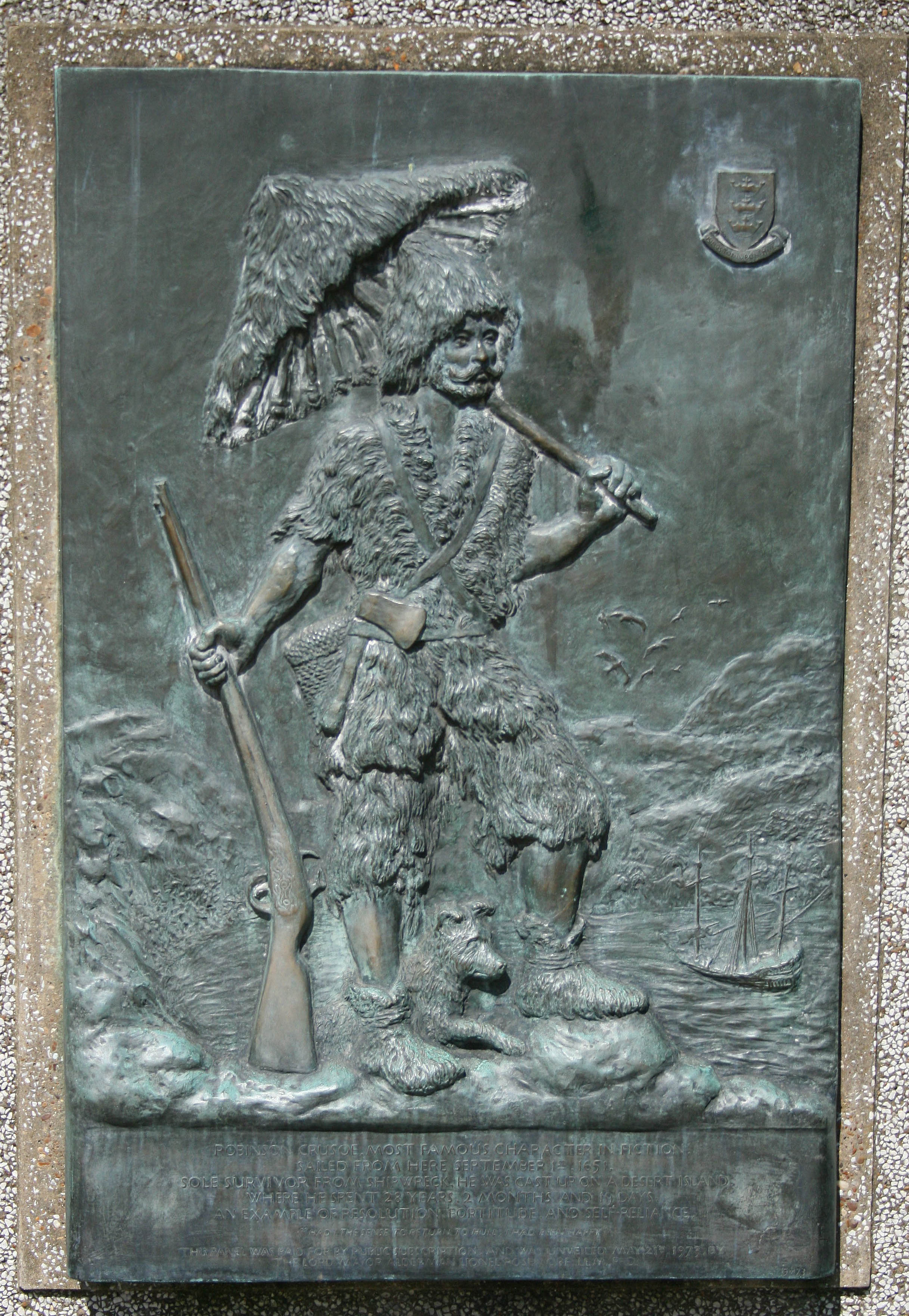
To my eye they look like a pretty good representation of Robinson Crusoe and Friday and I would suggest that the exotic foliage around their heads represents the lush jungle of their island home. It also looks as though the Crusoe figure has been modelled on the classic depiction of him in some of the Victorian editions, like this one taken from the Wiki entry  .

I think this is looking pretty plausible, so running with it for a while I was wondering if there might be an obvious link  between Robinson Crusoe and the name of the building 'Norfolk House'.

Well after copious amounts of dedicated research (hem, hem...) I'm happy to report that there is a link, but it's not all that obvious. Crusoe, it seems, was an unlucky mariner from the very start and after running away from home and boarding a ship from Hull managed to get as far as Cromer off of the Norfolk coast before sinking! He then walked to Yarmouth where he found some aid and assistance and wondered whether the fates were trying to tell him something... Very tenuous then, but luckily not the only one as it turns out.

The other link is to do with the name 'Robinson Crusoe' itself, which when you think about it is quite an odd name. The book itself explains its background
...my father being a foreigner of Bremen...settled first at Hull. He got a good estate by merchandise, and leaving off his trade, lived afterwards at York, from whence he had married my mother, whose relations were named Robinson, a very good family in that country, and from whom I was called Robinson Kreutznaer; but, by that usual corruption of words in England, we are now called - nay we call ourselves and write our name - Crusoe; and so my companions always called me.
This is quite a bit of background colour in order to come up with such an unusual name - why not stick to something like Jack Jones or something? - but it looks as though the author Daniel Defoe may have picked the name up already before he even wrote the book. Defoe enjoyed and wrote about the town of King's Lynn in Norfolk, and as noted on the Literary Norfolk website  'In his A Tour Through the Whole Island of  Great Britain Daniel Defoe was hugely impressed by King's Lynn preferring it, in many ways, to both Norwich and Yarmouth.'  What Defoe might also have noticed would be the graves and gravestones in St Nichols' Chapel, Kings Lynn which happen to contain the earthly remains of several individuals by the name of Robinson Cruso!

Even if there's no real solid link between the figures of Crusoe and Friday (who incidentally, survived to appear in the sequel only to die half way through with three arrows in his chest) and the county of Norfolk, it was still very intriguing to spot what seemed to be a literary reference in a spot of doorway ornamentation. 'Norfolk House' is more than likely a bit of a red-herring - it could just  be that the owner enjoyed a good read!

Thursday, 11 March 2010

Up The Garden Path (and what you might find there...)

I was out and about in Longley Road, Tooting this lunchtime when I noticed a couple of interesting garden paths. Now I know that's the sort of opening line that if used at a party would ensure you'd have a nice quiet evening all by yourself but it did raise the question in my mind as to the status of the humble path, not something I'd really spent much time on before (and I can't think why...)
It seems to me that most architectural detail tends to relate to the building itself but the path to the front door is often caught between two worlds. It is sometimes called upon to act as a sort of 'proto-hall' and throw its hat in with the building whilst at other times it remains resolutely part of the garden and the natural world and adapts itself fully to that particular role. Think of the differences between the extravagant mosaic or tiled path compared to the gravel drive - the former is basically saying that you're already inside (despite the lack of walls or roof) whilst the latter with its crunching not only reminds you of a beach at low tide - emphasising your sense of 'out-sideness' - but also serves as a warning of your approach. You are very much in the garden world when you walk on gravel.
Of course there's always the middle way that most of us end up with, namely of a bit of concrete, a few slabs from B&Q or a ribbon of tarmac but that seems so fully utilitarian as to be almost devoid of any imaginative spark or interest. Not that a gravel path is much better but it does at least have a sense of life about it somehow as it gets moved about into various banks and drifts, grinds satisfyingly underfoot and can even find itself being picked up and thrown around by small children, giving it a sort of kinetic quality all-round.
The examples that I found down a single road seem mostly to have been created to a specific formula and method, with a tile 'carpet' being laid into a concrete base. Most of the others haven't survived and have either been covered over or torn up, but these ones struggle on showing how difficult it is to maintain that highly desirable 'house coming out to greet you' look over any length of time. Tiles fade, crack, lift in frosts, succumb to subsidence, face an unequal struggle with mould and weeds and generally start to look a bit tatty. Of course that's when Faded London likes them best but really you'd have to admit that their glory days are pretty much behind them at that point. 

I don't think it helps that the fine old family houses they serve are now divided up into flats although it could be a double-edged sword. Would a single owner have lifted them in the 70s and put down something more modern, like the neighbours? Or could it be that having an absentee landlord means that they are willing to leave the paths there for as long as possible, even if they're not going to maintain them?
The most successful survivors seem to be the paths based on solid blocks of colour - mini-mosaics that retain the layout and the depth of colour - but the most interesting are those that use tiles with patterns or designs on them. You know there's no chance of finding replacements for those tiles that have given up the ghost and been rubbed bare and once these paths get past a certain point you know it'll only be a matter of time before they're gone for good
So although I'm willing to accept that they may not be the most exciting of objects I do have to admit to finding them quite appealing and more than worthy enough for a brief acknowledgement and a salute before any final appointment with a pick-axe and a small skip.

Sunday, 2 August 2009

Mitcham Road & Longley Road (Part 2)

Turning down Longley Road was no accident as I wanted to take a closer look at a building that had intrigued me on an earlier visit about a year ago. The building in question is Jubilee Villa and it is one of those buildings that just makes you stop in your tracks for a closer look (whether or not you're writing a blog)
Dated 1887 the building was presumably built in the same year as Queen Victoria's Diamond Jubilee but what is really striking about the house is its shape (triangular, with a rounded end), the coloured glass windows and the profusion of tiles. If a house could shout out 'I'm Arty!' it would be this one!

With such distinctive decoration you'd assume there would be a story to tell, but if there is it's pretty well hidden. A search on the internet only reveals one significant mention and that is in an article on notable tiles, borough by borough, by Independent Architectural Historian Lynn Pearson Significantly though, she provides much of the background information.

The following extract was taken from her book Tile Gazetteer: A Guide to British Tile and Architectural Ceramics Locations
Tooting Jubilee Villa (1887), 156 LONGLEY ROAD, is something of a showpiece for Maw & Co’s products with seven tile panels on its facade including transfer-printed pictorial tiles by Owen Gibbons, who had worked on the decoration of the South Kensington Museum during the 1870s and produced many designs for Maw’s during the 1880s.
Overlooking the road, this blocked window is
in-filled with Maw & Co's trademark floor mosaics

Maw & Co
are still in existence and still in the quality floor tile business although these days they seem to specialise in the repair, maintenance and restoration of their original Victorian floors. Apart from this window and the tiles in the name plate, most of the other tiles on display are of the wall variety in a range of different 'sets'

A mixed bag of tiles including some with floral and Japanese influences.

The set of tiles underneath the in-filled window seems to be the least coherent set. It consists of ten tiles, three of which are blue and seven a dark brown, Several of the tiles include a young lady in a variety of actions so it could be that they formed part of a set, but you can't really say that there's any overall theme.
Detail of four tiles. The two seaside views are the only ones that have any obvious thematic link

The other side of the main door and it's a different scenario. Here there are two sets of ten tiles beneath two windows but very much similar in content. The middle six in each set are part of a single thematic set depicting various tradesmen.
A closer look and you can see them all hard at work, flanked by a couple of more standard designs.
Get in really close though and not only do you get to see exactly what he's up to but you can also make out the trade depicted as it's name is picked out in all four of the corners - in this example reading SH - OE - MA - KER. Other trades represented are Tailor, Smith, Cooper, Smith and PainterThe second panel completes the set and comprise the trades of Founder, Navy, Sawyer, Shipwright, Carpenter and Bricklayer
Around the curved front of the building, either side of the name plaque, are two other sets, this time of six a set and two 'fillers'. This particular set comprise of the twelve months of the year although it's not at all obvious from ground level
Even when you look at the set as a whole it's not too clear what exactly is being depicted. This is the left hand panel...
And this is from the right of the name plaque.
When you zoom in though you can see the subject matter, the name and the number of days for each of the months. In this example we have a typical May Queen ceremony......and here in August the wheat harvest is being helped in with a touch of cider.
I suppose what intrigues me with this building is how it came about in the first place. Was the name plaque commissioned initially and then some silver-tongued salesman persuaded the owner to invest a bit more? Was the owner an employee of Maws and so able to obtain them at a decent price? Was the owner an artist himself who decided on his own layout and coloured windows? Whatever the answer was it's a very attractive building.

Longley Road Further down the road is a fairly inauspicious chapel that looks like an in-fill between two larger building. The main feature of interest is the arch over the door with its date of construction - so it's a couple of years older than Jubilee Villa then.
There were quite a few coalholes around as well but this one stood out with its Battersea-based Ironmonger.
This intrigued me as a slightly unusual sight with the plaster moulding in the centre of the building being echoed by some infilling of the roof-line. I can't see that it serves any other purpose than a decorative one and no-one else seems to have followed suit in the road
And, to round off the walk, a Blue Plaque for Sir Harry Lauder a Music Hall star from the turn of last century. Presumably this was a convenient location for his work in the London Music Halls. Those not familiar with his work might find this recording of one of his greatest hits of interest and a suitable end to a short but intriguing walk. Well, I might not have been exactly Roamin' in the Gloamin' (more like Tootling in Tooting) but even if short it was an interesting stroll.

Tuesday, 28 July 2009

Mitcham Road and Longley Road (Part 1)

This is a short walk that started out as a lunch hour trip dash with the intention of photographing two intriguing pediments but ended up with enough intriguing bits to warrant a two-part post. It wasn't meant to be that way, but with the opportunity to take the walk back to work in a more 'interesting' way there was always a chance of coming across a couple of other intriguing items

This is the route taken - although being just the two roads it hardly qualifies as a route

View Larger Map
OK just to set the scene, I'd seen a couple of intriguing pediments just down Mitcham Road, Tooting and decided to pop by to get a decent photograph of them and then hopefully work out what they were.
As you can see they are on granite pillars and flank a fairly unassuming shop. The building itself is stepped, with a further story set back from the one visible in the picture. The pediments were unusual in having text upon them and were quite intriguing when you had a closer look.
Industry shows a distinctly Medieval blacksmith hard at work, shaping and beating iron out into a useful shape with his assistant in the background
And flanking it is Agriculture with the Medieval ploughman wearily working his furrow. Now this is fairly specialist stuff and not the sort of thing you would expect to find on any old shop-front. So was there more significance to their presence? The linking of Industry and Agriculture in this way immediately makes you think of the hammer and sickle and other socialist symbolism. Could this site originally have been a co-operative shop or possibly a meeting place, a mutual building society or other financial institution, or even an educational 'self-improvement' hall?

Having taken my photos I was thinking about making tracks, but as it was a nice afternoon I decided to make a stroll of it. Good job I did, because about ten shops up the road I came across another set of pediments!
They are obviously contemporary with the other ones and in exactly the same form. The themes are slightly different thoughTravel isn't something I'd immediately identify as a key concern of the working man although it's a very nice depiction of a steam train with a viaduct in the background
Commerce hasn't fared so well having been sliced in half to make way for ...well something really plain and boring really. From what's left I assume that that it used to depict a sailing ship in a dock.

All of which is really interesting, but it also implies that the pediments were a series of artistic designs rather than having a link with the shop beneath them. It also makes you wonder if there were originally many more along the parade which have been lost over the years. Could there have been some sort of link with any of the Great Exhibitions maybe? Any thoughts gratefully received...

The Mitre, Mitcham Road So off I went on my way and soon came across a splendid looking Inn called the Mitre. I assume it used to be a coaching inn and down the side I found these interesting grates, presumably for ventilation of the cellar area. The one on the right was especially ornate.
The Inn itself was banded with descriptions of the delights on offer 'Luncheons, Billiards, Cigars, Superior Ales' etc. and this went all the way round the back to the old stable block, still in place at the rear of the building, albeit with a distinct lack of horses these days.
Mitcham Road, Amen Corner There's an interesting building just where the road bends. Quite stylish and I would guess Victorian in age. There's no clue as to what it might have been that I could see, but I wondered if this metal post might have originally been capped off with a gas-lit 'Police' sign? The more modern police station is just round the corner and it's tempting to imagine this as possibly the original - and now outgrown - station (apparently the new station is now too small and the police have moved on yet again)
Certainly the boot-scraper has a sturdy no-nonsense air about it and looks as though it's been especially braced for the onslaught of a Victorian policeman's boot!
Mitcham Road nr Tooting Station Sitting on top of a non-descript '30s building was this plaque with the inscription "Progress - HP- 1934" What could it have been referring to I wonder? Was HP an individual or a company? (although I'm assuming it wasn't Hewlett-Packard!) Again I was wondering if this might have been the site of a co-operative shop?

So that was another intriguing mystery to end that section of the walk. There was another one just waiting for me down Longley Road though!

Monday, 8 June 2009

"It's all at the (South Suburban) Co-op NOW!"

Along with vague memories of its old advertising jingles, the Co-op store is still a familiar sight on the High Street and there's a reasonably sized supermarket version on the corner of Rose Hill roundabout on the Sutton/Morden borders. What is possibly of more interest though (unless you're on the lookout for a sandwich, as I was last week) is this elegant and very large pebble dashed plaque on the side of a nearby 'Landlords Furniture' shop on Rosehill Avenue (and to be honest I never thought I'd ever use the words 'elegant' and 'pebble-dashed' in the same sentence). Although the area is generally of 1930's vintage, and the sign is probably not of any great age, it is quite intriguing when you notice it. There might well be people reading this who worked for the company and certainly would have have been customers. It was all new to me though so I had a bit of a dig around to find out a bit more about it.
Wikipedia is always worth a punt and indeed it gives a potted history of the Society. Basically it was an amalgam of several smaller local co-operative societies operating in Surrey and Kent. In the early days these sort of societies provided a whole range of services and goods for their members, from milk to coal, books to funerals, food to furniture and any profits at the end of the year were paid back to their members in the form of a cash dividend or 'divi'.

However, reading around the subject solved another minor query. I had a photo of a stately building in Tooting, now a function hall, that had an RACS Ltd pediment. At the time I didn't know what it stood for but I now know that this was a building belonging to the South Suburban Co-Operative's big local rival, the Royal Arsenal Co-Operative Society!
I found some information about the Royal Arsenal Co-operative Society (including some reminiscences that claimed that RACS stood for 'Robbing All Customers Slowly', which seems a bit harsh) that shows that its acquisitions included the local Wimbledon Co-operative society, so it looks as though Morden might have been the border 'badlands' between these two local powerhouses. By all accounts there seems to have been some rivalry between them but ultimately it did them no good as they were both absorbed into the national Co-Op in 1985 leaving little more than a few plaques and name plates to tease the curious!
One last thing I never knew about the Co-Op, but found out reading around them, was that it has its own political party. In fact it has up to 29 MP's, including Ed Balls but you're not likely to know that as the Co-Operative Party has allied itself with the Labour Party so closely it no longer campaigns as an individual entity, even though it still aparently exists and functions independently. Its MPs are listed as being members of the Labour & Co-Operative Party, rather than just the Labour Party, but the fact that its official party colour is grey probably suggest that they don't spend as much on image consultancy as their Labour colleagues