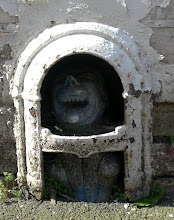
The first set of plaques have a distinctly military air about them.
There are several busts of a distinguished gentleman on the walls of some neat houses near the old village of Morden where Central Road meets Green Lane , along with some other decorative relief work. The fact that the estate is known as the 'Haig Homes' gives a pretty good idea as to who the soldier in the roundel below might be and it's no surprise to find the figure is actually of Douglas Haig, the 1st Lord Haig (1861-1928)
 The image is repeated several times around the estate and isn't one specially commissioned for these houses at all, but is taken directly from his memorial at the Scottish National War Memorial in Edinburgh Castle. Having been one of the senior military commanders of the First World War and one of the generation of generals reviled for the huge loss of life involved, Haig then spent his retirement - and some of the profits of the family whisky business, I'd assume - providing decent affordable housing for the survivors.
 I'm assuming that this is a representation below is of the dove of peace and symbolises a haven for soldiers who have experienced the horrors of war and survived to an old age. If not then maybe a carrier pigeon from the first world war. Unlikely, but you never know...
 This site in Morden is the largest of the Haig estates and was built between 1928 and 1930. In 1931 King George V was present for the official opening on probably his first and last trip to the area! I have seen a picture of the King at the opening but frustratingly can no longer locate it, although I've no doubt that Haig Homes themselves would have a copy in their archives. The best I could do was this article in a Haig Homes magazine which shows his oldest son, the Prince of Wales, talking to some of the residents. Not quite as exciting but no doubt I'll find the other picture eventually.
There were a couple of other inscriptions around as well, like this one for example. It isn't the easiest plaque to read, but says something along the lines of
The Gift of Memorial Homes. One of Two Provided by R. K. Kielber Esq. and the name Alexandra Square was chosen by him to express the gratitude of Denmark to the Great Field Marshall
 Alexandra was the name of King George's mother so would have been a most acceptable choice!
So that's one King George connection on my short trip, now where's the next?
The second set of plaques can be found either side of the (seemingly) permanently full car-park of the nearby King George's Park Playing Fields, home of Morden Little League and my ultimate destination. I had a vague feeling that King George seemed to come up quite often in the context of parks and playing fields, but it was only when I had a closer look that it really dawned on me before that there might be a particular reason for that.
 An apparently pretty standard set of King George Playing Field pillars
...be styled 'King George's Field' and to be distinguished by heraldic panels orSo up and down the country, sitting outside numerous King George Playing Fields are these heraldic tablets, designed by local artists and acknowledging local materials and traditions.
other appropriate tablet medallion or inscription commemorative of His Late
Majesty and of a design approved by the Administrative Council.
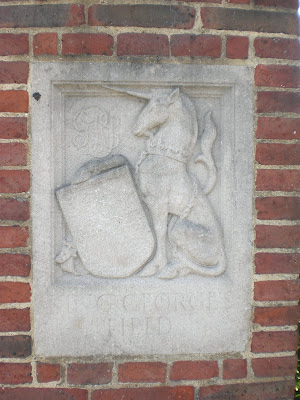 Unicorn on the right pillar...
The Morden ones seem to made out of concrete set into a brick entrance. The depictions themselves are a little worn but still readable, and clearly depict a Unicorn and a Lion - both heraldic animals from the Royal coat of arms
 ...Lion on the left. Everything in place here then!
There are strict rules about the design and execution of these panels which are taken from the charity guidelines
Heraldic panels were made of either stone or bronze and, in some cases, brass. These panels were, and still must be, displayed at the main entrance to the field; the Lion panel to be fixed on the left of the entrance and the Unicorn panel on the right, except Scotland. Where the piers of the entrance are of brick or stone, the panels were of stone 2 ft (1 m) high by 1 ft 6 in (0.46 m) broad. Where wooden posts form the gate-supports, smaller plaques in bronze were issued - 11¼ins high by 8¼ins broad.
In the case of England, Wales and Northern Ireland, the panel on the left is the Lion, holding a Royal Shield, with the words 'George V' underneath, and below them 'A.D. 1910-1936'; and on the right is the Unicorn holding a similar shield with the words 'King George’s Field' underneath. In the case of Scotland, the relative positions of the Lion and the Unicorn are reversed, and the Scottish arms take prior place in the Shield and the Unicorn wears a crown. The wording below is identical.These panels are essential to the heritage of the Foundation. Subject to the Deed of Dedication, the fields are, in most cases, established on charitable trust and protected in ‘perpetuity’. The NPFA is glad to give initial guidance and the necessary information on the specific design.