London is a city constantly re-inventing itself, but every now and then there's a window on to the past. It might be a washed-out advert painted on a wall, a plaque, an architectural quirk or elaborate man-hole cover - all worth recording before they are finally removed or hidden.
(CLICK ON PICTURES FOR LARGER VIEW)
We went for lunch up at Borough Market this week so of course I took along the camera, just in case. As it turned out I spotted an intriguing ghost sign and few other odds and ends. Lunch and photos...lovely! Southwark Street, Borough SE1 Most 'Ghost Signs' that are spotted tend to be painted on brick walls and the sides of buildings. It's not quite as usual to come across one painted on wood - not least because of its unfortunate tendency to rot away over time - so I was really pleased to spot this one the other day. It's unusual on several counts; firstly it's on wood; secondly it's very tall and thin and thirdly because of it's position under a railway line.
It seems to have been made as a specific infill between two other buildings, although it's not clear what's behind it, and my guess would be that it has been covered up until fairly recently. There's a central wooden batten that looks a lot newer and the fact that there's not much graffiti also suggest it hasn't been exposed for too long.
I couldn't fit it all in so had to make do with three separate sections:
The top section reads
FARLOW (?) & ROBERTS SHOP FITTERS BUILDERS CONTRACTORS
SAW PLANING MOULDING M?? 5 RED CROSS??
ESTIMATES FREE FOR ???DS OF BUILDING W?? STRUCTURAL ALTERATIONS FR?? & DEL??
All very mysterious. I assume they must have had a yard close by and this site provided a handy bit of free advertising.
The Hop Exchange, Southwark Street SE1 This little bit of advertising was a bit more expensive I'd assume... This is the magnificent entrance to the Hop Exchange and the relief shows the cutting and bagging of strings of hops. I like the hairy 'Green Men' too which gives the whole scene a definite pagan feel.
Southwark Street SE1 The Menier Chocolate Factory not only has a very attractive front door, but also two ghost door numbers who seem to have survived by being hidden under a brass plate or something similar
Park Street SE1 An unusual and very sturdy bootscraper this one and one of a pair outside a couple of attractive old town houses. Big enough for a small child to stand on I'd reckon. Sadly I didn't have a small child with me so couldn't try out my theory. Union Street 'Mint & Gospel' - excellent name! Actually the fact it refers to the Shaftsbury Society means that this plaque dates from after 1914, the date the Society was founded. Before that it had been known as the Ragged School Union and this had been one of their London Schools. It seems that the establishment of the Education Act of 1870 meant these charitable institutions no-longer were the sole providers of education for the destitute young and as their role slowly diminished it seems that the Shaftesbury Society eventually evolved into the YMCA. The building itself is dated 1909 so the plaque must be a few years younger, possibly being added five or six years later. Nice reminder though. Here's the proof then, the foundation stone dated 1909. There's a nice photo of Lord Mayor Treloar in the National Portrait Gallery and as he founded
the Treloar Trust, a charity supporting the UK’s leading specialist centre providing education, independence training and opportunities for young people with physical disabilities.
I'm sure he was more than happy to be associated with this particular venture! There are some interesting snippets on him on the Treloar Family web page- apparently he was known as "The Children's Lord Mayor", (which is not a bad appellation) as well as this photo Redcross Way SE1 We're not finished with the old Ragged School yet! If you go down the side of it you can see two strange creatures baying at the moon on the very top of the rear wall. My poor little camera was at maximum zoom and you can just make out that they appear to be a Dragon and a Gryphon I assume these are references to a heraldic design - possibly the City of London, given that the Mayor laid the stone - but it seems their coat of arms consists of two Dragons. Dragon and a Gryphon look familiar though....it's not Camberwell either. Newcomen Street, SE1 This is a detail from a house that seems to have gone overboard on the decorative detail. In fact every window on the first three floors (and there were about eleven of them) each had two different heads decorating it. The ony plain windows were those of the servants quarters up in the loft!Very nice details though and I was wondering if there was a theme to it all that was above me... Near Borough Tube Station I do like a nice pediment and lets be honest, how often do you see one with a cheeky weasle peering over the top? Actually he could be an otter, fox cub or stoat but it's not helped by having a few chips of the old block. And finally, from the same area, an intriguing set of symbols. Too boring to be decorative, they must have some significant meaning. Any thoughts?
When I hit the Old Kent Road, my first impression was that it reminded me of the Purley Way, Croydon, which is probably not going to mean a great deal unless you've ever been suckered into approaching the great black hole of IKEA. If you can recall your last sights before the Swedish gravity-well sucked you in, well that's the Old Kent Road that is...
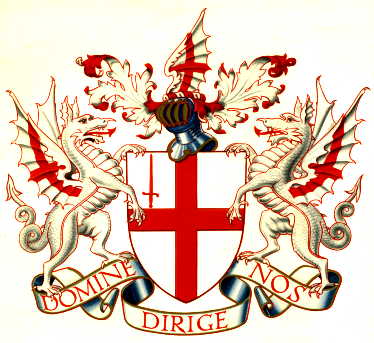
Heading west though, those first impressions fade a little as the various warehouse stores give way to a mixture of retail and residential, including a series of mature but well-built flats all topped off with a Corporation of London crest. This is quite intriguing really as the corporation is the body that runs the 'Square Mile' on the north bank of the river, better known as the City of London. As you can see the crest with its rampant dragons is that of the City and the motto means 'Lord Protect Us', so what is it doing in Southwark?
According to the City of London website
The land on which Avondale Square Estate is situated has been owned by the City of London since 1251. Redevelopment of the Square commenced in 1920 and continued after the war. The estate is comprised of over 600 flats and maisonettes, three play areas and a community centre.
There was very little that I spotted of interest down the Old Kent Road until I reached the junction with Albany Road. I could see some older buildings lining the roads and down a side road, possibly Rowcross Street, I saw this interesting sign. Rowcross Street I'm not saying this is a ghost sign or anything like that, although it would be interesting to know when it was painted, but what caught my eye was the picture of the glazier. The words 'shifty', 'devious', 'malicious', 'untrustworthy' and even 'un-dead spring to mind. Was the owner really pleased when they saw what the painter had produced? And what's he looking at??? Creepy stuff really... Old Kent Road - Thomas a Becket Pub Well this was an unexpected pleasure that bought back a few memories. The local Council had erected a Blue Plaque in the doorway which read
Sir Henry Cooper OBE, KSG Born 1934 British, European and Commonwealth Heavyweight Champion trained in the gymnasium of the Thomas a Becket. Voted by the People
Well done the people. Some of my most vivid memories in childhood were the evenings I'd spend listening to Henry Cooper's fights on the radio. His potent left hook (aka 'Enry's 'Ammer) and his tragic flaw, his susceptibility to cut around the eye. Which would triumph?I think it was that what if aspect about Cooper that made him such a hero. His fights were invariably a race against time and as soon as the commentator said '... and there's blood above Coopers right eye' your heart sank. You knew that he'd battle on as long as he could but like all tragic heroes, the Gods would be too strong for him in the end and the fight would be stopped when he could no longer see to land a punch. His final defeat by Joe Bugner was the end of an era. The last of the heroes had been despatched by a mere mortal. Non-British readers might not have a clue who I'm talking about so here's a fight where Henry's cut eyes and his left hook both feature.
Old Kent Road I haven't had a decent capital for ages, so it was nice to spot this long and elegant example sitting on top of an oak leaf cluster Mason Street off the Old Kent Road Up by the roundabout with the New Kent Road is an old school which now seems to be an administrative block. I was quite taken with this blocked up doorway, a sort of 'Ghost Entrance'. I'm so enthused I might even see if I can get a ghost-entrance/window posting together, assembling all those bricked-up doorways and windowsthat no longer go anywhere. Using the underpasses I emerged from the Old Kent Road roundabout/flyover down Great Dover Street. For some reason I was intrigued by a side turning and left what was a pretty non-descript main road. Cole Street I'd seen these 'ghost street signs' before, but it's always interesting to spot another. I'm not sure when or why the practice of painting street names fell out of favour, but here we have the old and the new sitting side-by-side, with the former gently fading into oblivion. Trinity Church Square Now I had one of those "Well I'll be..." sort of moments as I came across what seemed to me to be the perfect realisation of a Georgian Square, complete with Church (now the Henry Wood Concert Hall) and enclosed green space. It really would not have looked out of place as a set for 'Oliver!' and was a nice vindication of the 'follow your nose' school of dithering (along with the abrupt left turn that took me to the Angel pub earlier in the walk). I assumed the square was named after the church, but the Trinity reference is actually to the Trinity House charity that were responsible for much of the lighthouses around the coast of Britain. Not only have the buildings survived but so to have many of their features, such as coalholes and boot-scrapers. The coal-holes are all made by Hayward Brothers and seem to be of a fairly late design, which suggests that many were replaced at the same time. Changing over to the famous 'safety plate' maybe? I didn't take any photos of the coalholes as they were fairly standard, but I was intrigued by the bootscrapers, which were of several designs.
This example is quite an elegant effort. I think it might be two herons kissing over a scallop shell. Or then again it might be two fish with spiky tails touching over a scallop shell. It's a boot-scraper equivalent of an ink-blot test... Whereas this one is obviously two cats fighting over a ball of wool. Of course you could go for the basic 'bolt a flat piece of metal between two uprights' soloution... ... or the more elaborate and humane 'build a funnel to stop the mud falling down the basement and onto the servant's heads' scraper, although no doubt it was the servants that ended up cleaning it out. And finally the 'well there's a space here so why don't we put a scraper in?' variety. The Surrey Dispensary - Trinity Street As I was leaving the Trinity Church Square I saw this intriguing building on the corner. Obviously of some significance and age there was no clue as to what it might be. A quick search on Google books gave the following quote from The People's Health 1830-1910 by Francis Barrymore Smith
'Free Dispensaries' were established by doctors with the backing of philanthropic donors who retained the right to recommend deserving patients. Often free dispensaries were linked with missions, especially amongst the Wesleyan and evangelical Anglicans. The Surrey Dispensary, Union Street, Borough, was an Anglican institution. The nearly 200,000 cases its managers claimed to have relieved between 1778 and 1840 included over 31,000 confinements.'
Nice to see the building's still there, though I'm not sure what it's used for these days. Trinity Street Here's an enigma. A coalhole of fairly non-descript design with the single word 'Durey'. I assume it was the name of the manufacturer, but it doesn't look as though they had much of an imagination. Hulme Place, Southwark SE1 A second set of bollards caught the eye. Possibly because of the rugged no-nonsense shape and design, but also possibly because of the black and white banding. Surely the mark of a proper bollard?
Maya House, Borough High Street SE1 As it happens I'm putting together a posting about modern 'eye-catching' installations and I reckon this one will have to feature. Reminiscent of the famous New York 'Blue Man' theatre group, this building seems to have a set of blue musicians scaling its side. Why? Who can tell... Looks interesting though. Borough High Street, SE1 This interesting mosaic was outside a pub on the High Street. Strange that it was also built with a mighty supporting pole obscuring the entrance as well. Cant be the best bit of planning on a Saturday night... Borough High Street, SE1 Then just up the road was this fine example of a lightwell, all the more interesting as it came from a manufacturer new to me, Parker, Winder & Achurch Ltd. Looks as though they were a Birmingham company and had a finger in several other pies, as this photo shows! And finally, just as I was walking down the High Street back to the tube station, a glance over the shoulder revealled a fine Ghost Sign. The Monster Clothing Establishment, Borough High Street, SE1 "Paris, Antwerp & Ghent" it says. I'm not sure why they left Borough off the list but it was a releif to stumble across at least one, bona-fide, dyed in the wool, no-nonsense ghost sign before heading for home. On the whole I would say that it was several hours well-spent. I've discovered some new places and bits of history I wouldn't have been aware of, either by seeing them, reading up on them or by having people post comments on them. It's true that I've obviously skirted Bermondsey (which deserves amore detailed visit) and that I didn't find much to excite me on either the 'Surrey Docks' nor the Old Kent Road. But then I did find an interesting old pub, a magnificent square, an untouched head office of a railway company and enough derricks to sate the appetite of the most ardent docklands enthusiast. Not bad for an afternoon...
With a bit of leave to take before April I thought I might take a stroll around a bit of South London that I've never visited before, so a quick trip up to London Bridge underground saw me set off in the direction of Rotherhithe. Ah Rotherhithe! What an evocative name, conjuring up visions of a London long-since passed - docks, slums, the entrepot of Empire (hem, hem!). So with nothing more than a vague idea I wandered off in an easterly direction and in the hopeful expectation of stumbling across ghost signs, Victorian buildings and relics by the score. Sadly I was to be disappointed. Like the Curate's egg it could best be described as 'good in parts'.
The walk was about 7.6 miles in all according to Google maps (I've plotted my rough route on there as well) and I can't say it was as interesting as I hoped it might be. To summarise, the first bit was interesting, then it got a bit repetitious, then flat out boring/depressing, rescued by a bit of relief, followed by more boring until it then blossomed in an unexpected fashion before settling down into interesting again. Confused? You will be..
Tooley Street setting of from London Bridge the first thing that strikes you is the number of interesting sites there are - and loads of them seem to have plaques or links to earlier buildings. The South of the River has always been the unfashionable side, but being sandwiched between London Bridge and Tower Bridge obviously made up for that and I'd guess that there were many important companies located in the area. My first picture is of a memorial plaque to James Braidwood, superintendent of the London Fire Brigade who was killed here in the Great Fire. Well to my way of thinking the Great Fire would have been that of 1666, long before the London Fire Brigade even existed, so a bit of research turned up some interesting facts about James and the Tooley Street Fire of 1861. Tooley Street Slightly further up the road but still with the trains evident were these old offices of the South Eastern Railway Company, a company that was absorbed into the generic Southern Railways Company following rationalisation in 1947. Nice that the façade hasn't been touched though.Tooley Street (nr Bermondsey Road) What I thought was interesting about this pub (The Shipwright's Arms) was the use of a ships figurehead to adorn the front door. I've no idea if she's authentic or designed and commissioned specifically for the pub but she's certainly eye-catchingTooley Street Just outside the pub was this Haywards Brothers coalhole. Based just down the road you'd expect Haywards to be the main supplier to the are and so it proved. What I like about this one is that just being off the main drag it's retained th quality of mould ings that mean it's still easy to readTooley Street. Just before Tower Bridge I noticed this fine rain-water conduit dated 1901 but I've no idea what the 'B' stands for.Tooley Street Another interesting plaque that caught the eye. Tooley Street. What exactly is a Sprinkler Stop Valve and when would you want to use it? Anyway, there's one inside but god knows if it's working. off Tooley Street I had to come off Tooley Street and into a small side street to come across this intriguing milestone. The faces have the points of the compass but it seems to be 6 miles to "O& I". Where on earth might this be? No doubt obvious when told, it remains a mystery to me for now... Queen Elizabeth Street I wasn't sure what this sightly shabby building was although it did have the look of a library or possibly an ancient military hospital about it. Very nice weather vane though. Queen Elizabeth Street This Coat of Arms is one of several around the base of a statue to Colonel Samuel Bourne Bevington, first Mayor of Bermondsey and something big in the world of leather. I don't know if these are his arms or Bermondsey's, but I'm going with the former.(and I was wrong! Thanks to W. Bevington and others who pointed out that these are, in fact, the arms of Bermondsey )Queen Elizabeth Street These bollards surround the Green. They look authentic enough, but those plates and bolts at the base give it away a bit. They must be modelled on an original design though and still quite easy on the eye... Tooley Street/Jamaica Road This is a lamp that used to illuminate the old police station next to the magistrate's Court on Tooley Street (or was it Jamaica Road?) Anyway, it's real 'Dixon of Dock Green' in style and very ornate close up Between Jamaica Road and the Thames Here there are several streets of old warehouses that have been converted in to prestige offices and retail outlets. All very tastefully done but all a bit ... antiseptic. The developers have scrubbed everything up to within an inch of it's life, but you can still spot the odd plaque like this oneThen of course you could spend ages admiring all the derricks, long since past their useful working life, just adorning the walls.To be honest I could have taken loads of photographs of these sort of derricks... ...but then it didn't seem fair. They are shadows of their former selves and are now little better than ornamentation, painted over and probably welded closed. They are more like museum pieces than faded icons... ...which is a bit sad really. It's still quite evocative to see rows of them on the sides of buildings and to imagine them lifting and lowering sacks, chests and bales all over the place but like the the rest of the area they're all scrubbed up...
...even if this picture does give you two for the price of one. Shad Thames by no means a Ghost Sign this old warf sign has been kept to give an air of authenticity and character to the placeIn the second instalment we leave the faded bustle of the Tower Bridge warehouses and venture deeper into Bermondsey and the back end of Rotherhithe! (to be continued...)
I hope you enjoy the opportunity to have a slightly closer look at some of those items of 'street furniture' that are often overlooked, especially if you live in the South West part of London. My real interest are those faded advertisement and shop names that used to proliferate on the sides of buildings and which are now faded and peeling and only rarely glimpsed peeking out from behind their modern replacements. But it doesn't do to be too selective so I'm happy to include anything odd, old or quirky that catches my eye!
Ghost Signs of South West London - The Map (I recommend you use the 'View Larger Map' button below)